A full set of intelligent mattress machinery industry brands
Mattress machines are exported to 150+ countries
Date:2026-09-15
When people search for how to choose a mattress, they usually think about firmness, sleeping position, materials, price, and comfort. For a mattress manufacturer, mattress distributor, mattress store, or mattress e-commerce company, the question is more complicated: How do you manufacture a mattress that is genuinely suitable for different sleepers, and how do you explain why that mattress is suitable with measurable evidence? A mattress should not be differentiated only by saying “soft,” “medium,” or “firm.” Its support performance can be engineered through the mattress spring structure, wire diameter, spring density, spring height, zoning method, comfort materials, and the relationship between the support core and the sleeper's body. This is why pocket spring technology has become an important foundation for modern mattress development. LianRou Mattress Machinery not only manufactures pocket spring machines and mattress machinery, but also develops customized pocket spring units for different mattress applications. The objective is to help manufacturers move from standardized mattress construction toward zoning, high-density support, adjustable-bed compatibility, glue-free structures, and eventually pressure-data-based personalized mattresses.
For a consumer, choosing a mattress normally means selecting an existing product. For a mattress manufacturer, choosing a mattress means first deciding which customer the mattress is being designed for.
A factory may produce a mattress for side sleepers, heavier sleepers, premium customers, children, users of electric adjustable beds, or consumers who prioritize environmental materials. These groups do not necessarily need the same support architecture.
The engineering decision should therefore begin with the intended sleeper and application, followed by the selection of the appropriate mattress material, mattress spring, pocket spring structure, zoning strategy and manufacturing process.
This approach also changes how a mattress is marketed. Instead of simply saying that a mattress is “comfortable,” a manufacturer can explain the relationship between the target sleeper and the construction: what type of spring is used, where support is differentiated, why the spring density is selected, and how the mattress responds to different body regions.
For manufacturers, this is the foundation of a more scientific product-development process:
Target sleeper → support requirement → spring architecture → mattress construction → measurable product proposition.
A coil mattress is a mattress that uses metal springs as a major part of its support structure. Mattress coils flex under pressure and recover when the pressure is removed. Common coil constructions include Bonnell coils, offset coils, continuous-wire coils and pocketed coils. Smaller microcoils can also be used in comfort or transition layers.
The function of a mattress spring is not simply to make the mattress softer or firmer. The spring system provides the structural support that receives the sleeper's weight, distributes pressure and contributes to the responsiveness and stability of the mattress.
Spring performance is affected by several variables, including wire gauge, spring shape, spring height, number of turns, coil count, steel quality and the overall mattress construction. Sleep Foundation specifically notes that coil count alone does not directly determine mattress quality; wire thickness, material quality, coil geometry and the number of turns also influence how a coil system feels and performs.
This is important for manufacturers because it means a mattress cannot be engineered simply by pursuing the highest possible spring count. The manufacturer must determine what mechanical response the spring system is expected to deliver.
A pocket coil mattress, also called a pocket spring mattress or individually wrapped coil mattress, contains individual springs enclosed in fabric pockets. Unlike interconnected coils, the individual springs can move more independently from their neighbors.
This construction can provide more localized response and contouring while reducing the amount of movement transferred between neighboring springs. Pocketed coils are therefore widely used in modern hybrid mattresses and premium mattress constructions.
For manufacturers, the greater significance of a pocket spring is its design flexibility.
The factory can change spring diameter, wire diameter, spring height, turns, density and the arrangement of different spring specifications. These parameters can be used to develop different support characteristics for different mattress categories.
This is where a pocket spring machine becomes more than a production machine. It becomes a tool for converting mattress design requirements into repeatable spring specifications.
LianRou develops pocket spring machines as well as customized pocket spring units, covering zoning pocket springs, supermicro pocket springs, electric-bed spring units, glue-free structures, double-layer spring units and other mattress spring solutions.
Traditional 3-zone, 5-zone, 7-zone and 9-zone mattresses divide the sleeping surface into predefined regions with different support characteristics. The concept is based on a reasonable observation: the shoulders, waist, hips and legs do not apply identical pressure to a mattress.
The advantage of this approach is that it is more differentiated than a completely uniform spring system. A manufacturer can make the central region more supportive and other areas more compliant according to a predefined body-support model.
However, these systems are still fundamentally standardized zoning systems. A seven-zone mattress has seven predetermined zones; it does not automatically measure whether an individual sleeper's shoulder pressure, hip pressure or body proportions match the assumed model.
This distinction matters when mattress brands begin targeting personalized sleep products.
The number of zones does not itself prove personalization. A mattress with more zones is not automatically more scientifically matched to a particular person. For manufacturers, the more meaningful development direction is to move from fixed zoning toward body-pressure-based support design.
That is the reason LianRou developed its Double-Layer Curved Pocket Spring concept.
LianRou's Double-Layer Curved Pocket Spring uses an integrated upper-and-lower spring structure rather than treating the mattress as a single flat spring plane.
The upper layer uses a relatively softer spring configuration and can be designed with different spring heights and turns. A taller spring with more effective wire length provides a softer response, while a shorter configuration with fewer turns provides stronger resistance. The lower layer uses a stronger spring structure to provide deeper support.
This creates a progressive support architecture.
In a heavier region such as the hip area, the upper spring layer can deform more deeply and conform to the body's shape, while the lower spring provides stronger underlying support. In lighter regions such as the legs, a higher and softer spring configuration can reduce the sensation of excessive support.
The result is not simply “soft here and firm there.” The objective is a gradual difference in support along the body-pressure curve.
According to the technical information supplied by LianRou, the concept is intended to provide different support around the head, neck, shoulders, waist, hips and legs, helping the mattress follow the physiological curve of the sleeper.
LianRou's published LR-PSLINE-DL Double Layer Pocket Spring Production Line is specified at 120 pairs/minute, with two servo coiling heads, servo control, and spring options of 1.3–1.6 mm wire with 42–52 mm waist diameter or 1.5–2.1 mm wire with 52–65 mm waist diameter, with a finished pocket-spring height of 180–230 mm.
The upper layer can have a minimum pocketed height of approximately 65 mm, while the lower layer can have a minimum pocketed height of approximately 80 mm.

The next development step is to connect sleep-pressure measurement with spring manufacturing.
A pressure-sensor sleep system can collect the distribution of pressure created when an individual lies on a mattress surface. Instead of giving the customer only a general firmness recommendation, the system can generate a curve showing where the body applies more or less pressure.
That information can then be transferred to a mattress factory as a design reference. The manufacturer can use the pressure distribution to determine where different spring heights, spring diameters, wire specifications or zoning structures should be applied.
The production concept becomes:
Pressure sensing → individual pressure curve → spring zoning data → customized pocket spring unit → personalized mattress.
This creates a different type of sales proposition for mattress retailers and e-commerce brands.
Instead of saying:
“This mattress feels comfortable.”
The brand can explain:
“This mattress is designed around your measured pressure distribution.”
That does not eliminate the importance of subjective comfort. Rather, it gives the subjective experience a measurable engineering explanation.
For mattress manufacturers, this can also create a scalable personalization model. Once pressure data is converted into standardized production parameters, customization does not necessarily mean producing every mattress manually. It can become a digital design-to-production process.
According to the first-hand technical information supplied by LianRou, testing associated with its double-layer curved pocket spring mattress reported improvements in pressure distribution and sleep-related indicators. The supplied data from the British “麦托阿伯丁” mattress test reports a 65% improvement in spinal pressure distribution uniformity and a 58% reduction in morning muscle soreness. Further sleep-monitoring data from the supplied “麦托邓斯” case reports 42 additional minutes of deep sleep and 37% fewer turning movements.
These figures should be treated as LianRou-supplied test/case data, rather than generalized medical claims for every mattress or every sleeper. Their strongest commercial value is as an example of how a manufacturer can move toward measurable mattress-development evidence.
The larger marketing principle is more important than any single number:
individual difference → measurable pressure → engineered support → test result → visible explanation.
For a premium mattress brand, this creates a more credible product story than relying entirely on adjectives such as luxury, ergonomic, orthopedic or ultra-comfortable.
A manufacturer should consider a Supermicro Pocket Spring Unit when the product requires a particularly dense distribution of support points.
The engineering principle is simple: when individual spring diameter is reduced, more springs can be placed within the same mattress footprint. This allows the support surface to be divided into more individual response points.
LianRou's Supermicro Spring Unit is designed around approximately 3,000–4,000 individually pocketed springs per mattress, creating a high-density support matrix. The company positions the product for high-end firm mattresses, high-elasticity mattresses and specialized bedding applications.
The supplied standard design uses fine wire and narrow spring geometry. This is relevant to manufacturers targeting customers who need detailed support, including side sleepers, higher-weight sleepers, premium firm mattress users and certain specialized bedding applications.
The important point is not that “more springs automatically equal a better mattress.” The value lies in the higher density of individual support points, combined with the selected wire specification and spring geometry.
For a mattress factory, this makes Supermicro Pocket Spring particularly useful when the product positioning depends on fine-grained support rather than simply overall firmness.
An electric adjustable mattress has a mechanical requirement that a conventional flat mattress does not: the spring core must repeatedly bend as the bed frame changes angle.
A conventional vertically arranged spring structure can encounter problems when repeatedly folded, particularly if the spring spacing and welding structure do not provide sufficient flexibility. The mattress core may develop gaps, bulging or excessive stress on the pocket fabric.
LianRou's Easy Folding Spring Unit for Electric Bed uses a special herringbone welding structure. The springs are inclined, creating built-in buffer space that allows the unit to adapt to different folding angles while maintaining close contact with the adjustable bed frame.
This is a different design requirement from ordinary flat pocket spring production.
For manufacturers of premium electric beds, the spring unit must therefore be evaluated together with the frame movement. The goal is to create a support core that can bend repeatedly without sacrificing the structural integrity of the mattress.
The spring unit can then be combined with conventional mattress materials such as foam or latex to complete the finished mattress construction.
For manufacturers looking to simplify the construction of an adjustable mattress, LianRou also develops spring units that integrate comfort materials into the spring structure.
The concept can incorporate materials such as sponge, crushed latex and cotton into or around the spring unit, providing part of the comfort function before the mattress cover is installed.
This approach can reduce the number of separate layers that must be assembled during mattress production. It also allows the spring core and comfort material to move as a more integrated structure when the mattress bends with the electric bed frame.
For factories, the potential value is not simply comfort. It is process simplification: fewer independent components, fewer assembly operations and a spring core that is already engineered for the intended application.
For mattress brands targeting environmentally conscious markets, a glue-free pocket spring unit provides another manufacturing route.
LianRou's four-leaf-clover glue-free pocket spring concept uses ultrasonic welding rather than conventional hot-melt adhesive bonding. The adjacent springs form a four-leaf-clover-type structure, providing independent spring movement and structural connection without relying on adhesive.
LianRou has also developed a production system specifically for glue-free pocket spring manufacturing. The published production range is approximately 120–160 springs/minute, with a double-wire coiling head, 1.6–2.3 mm wire, 55–75 mm spring waist diameter, and 120–250 mm pocket-spring height according to the supplied product information.
The company also offers a separate dismantling pocket spring structure using sewing technology. That design is intended for end-of-life separation of fabric and springs and therefore addresses recyclability from a different direction.
This distinction is important for mattress manufacturers: glue-free and dismantlable are not identical manufacturing concepts. One focuses on eliminating adhesive from the structure; the other focuses on enabling later separation of the components.
A mattress factory should not choose a pocket spring machine simply by asking which model has the highest springs-per-minute number.
The correct purchasing process starts with the factory's product strategy.
A high-volume manufacturer producing standardized mattresses may prioritize output, stable production and labor efficiency. A manufacturer producing premium zoning mattresses may prioritize CNC flexibility and different spring specifications. A personalized mattress manufacturer may need a machine capable of producing special spring structures. An adjustable-bed factory needs a compatible spring-unit design. An environmentally focused brand may prioritize ultrasonic or sewing-based glue-free structures.
Therefore, a professional pocket coil making machine evaluation should consider:
What mattress will be produced?
Which spring specifications are required?
How much production capacity is needed?
How many operators are required?
Is zoning required?
Will the factory develop customized spring units?
What assembly technology will be used?
Can the machine support future product development?
LianRou's product portfolio includes spring manufacturing machines, mattress assembly machines and complete pocket spring production lines, covering different production speeds and spring configurations.
The machine should therefore be selected according to the finished mattress, not the machine brochure alone.
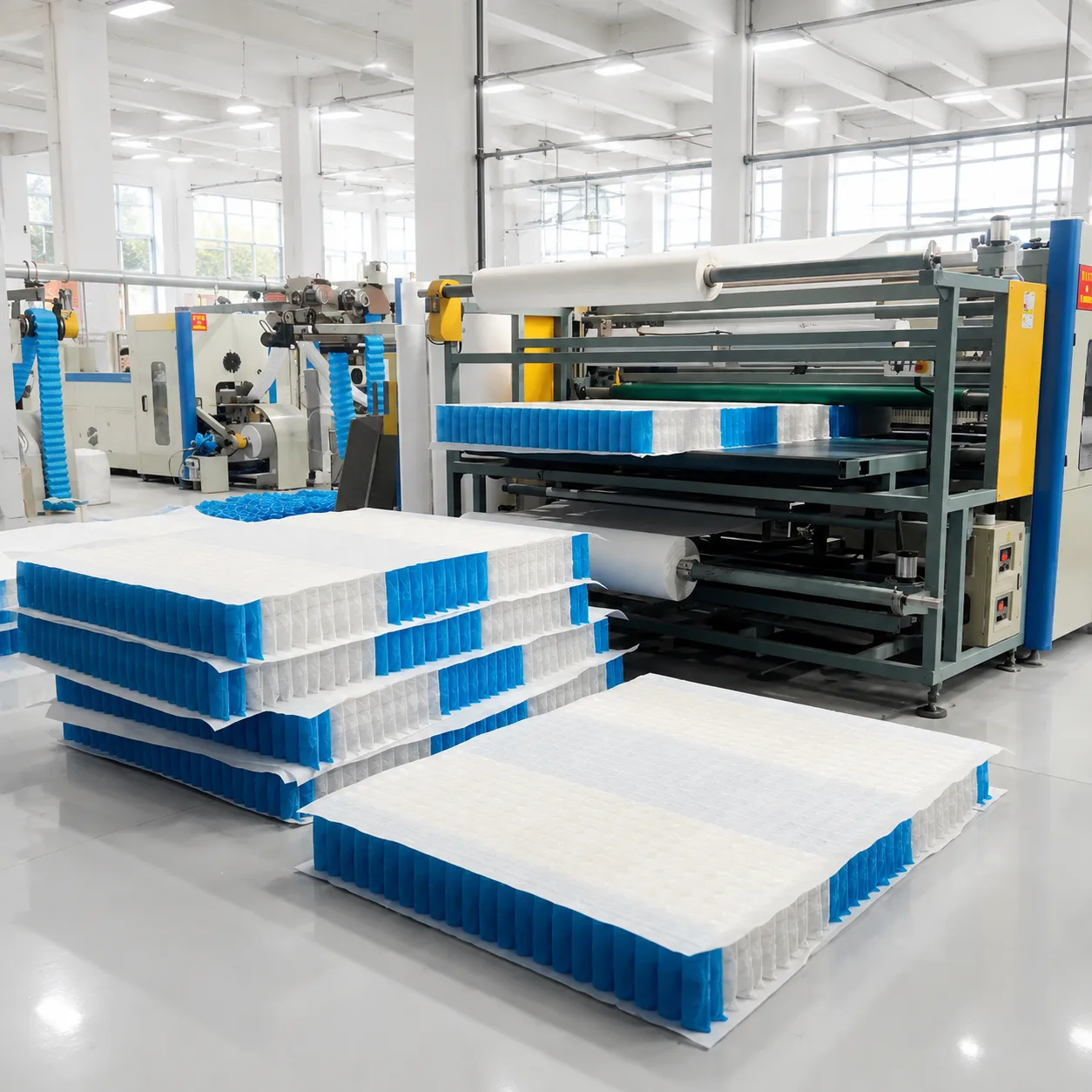
A complete pocket spring manufacturing process generally involves two major stages: making the pocketed springs and assembling them into a spring unit.
For a conventional pocket spring product, the production system includes a pocket spring machine and a pocket spring assembly machine. The spring machine forms and encapsulates the individual springs, while the assembly stage arranges and joins the spring rows into the required mattress-core dimensions.
For the LR-PSLINE-DL Double Layer Pocket Spring system, LianRou describes an integrated production solution for producing double-layer spring structures. The published machine configuration includes two servo coiling heads and an output of 120 pairs/minute.
The final mattress can then be completed with the selected mattress material, such as foam, latex, cotton or other comfort materials, followed by cover assembly and edge finishing.
LianRou's broader mattress machinery portfolio also includes mattress assembly machines, flat packing machines, roll packing machines, foam compression machines, sealing machines, border sewing machines and cotton-layer gluing machines.
This allows manufacturers to evaluate production as a complete workflow rather than purchasing individual machines without considering how they connect.
A premium mattress does not necessarily have to achieve differentiation by continuously adding thicker or more expensive comfort materials.
One alternative is to engineer more performance directly into the spring core.
A double-layer curved structure can provide differentiated upper and lower responses. A Supermicro structure can increase support-point density. An adjustable-bed spring unit can provide the mechanical flexibility required by a moving frame. A glue-free unit can change the joining method.
This creates a different manufacturing philosophy:
Instead of adding more layers to compensate for a generic support core, engineer the support core around the intended performance.
For factories, this can simplify product architecture and create a clearer relationship between manufacturing parameters and product positioning.
The result can be a mattress that uses a relatively conventional comfort layer while obtaining a more differentiated support response from the spring system itself.
This is where mattress engineering becomes a sales tool.
Consumers often struggle to compare mattresses because many brands use similar words: premium, ergonomic, supportive, soft, firm, pressure-relieving and comfortable.
A manufacturer can give its retail partners a stronger explanation by connecting product claims to measurable construction.
For example:
Customer profile → pressure distribution → zoning design → spring specification → mattress prototype → pressure test → product recommendation.
A mattress store can then explain why a particular construction is recommended instead of asking customers to rely entirely on subjective trial-and-error.
For e-commerce companies, the same principle can become part of an online personalization system. Customer data can be translated into a recommended support profile, while the manufacturer converts that profile into a production specification.
This gives the brand a more defensible reason for differentiation.
The commercial message becomes:
We do not simply sell a mattress with a particular firmness rating. We engineer the support structure for a defined sleeper profile.
That is a much stronger proposition for premium mattress manufacturing.
A coil mattress uses metal springs as part of its support core. The springs flex under pressure and recover afterward. Common coil constructions include Bonnell, offset, continuous-wire and pocketed coils.
A pocket coil mattress contains individually fabric-wrapped springs. Because the springs can move more independently, pocket coils can provide localized response and reduce motion transfer between neighboring areas.
No. Zone count is only a design parameter. The position, firmness difference and intended sleeper profile are more important than simply increasing the number of zones.
A zoning mattress uses different support characteristics in different areas of the sleeping surface. Traditional zoning may use 3, 5, 7 or 9 predefined areas, while advanced systems can use more individualized spring configurations.
It is a two-layer pocket spring structure in which the upper and lower spring layers perform different support functions. LianRou's system uses different spring specifications and heights to create progressive support along the body-pressure curve.
LianRou's Supermicro Spring Unit is designed around approximately 3,000–4,000 individually pocketed springs per mattress.
Yes. However, the spring unit should be designed for repeated bending. LianRou's Easy Folding Spring Unit uses inclined springs and a herringbone welding structure to accommodate changing adjustable-bed angles.
Yes. LianRou develops glue-free pocket spring structures using ultrasonic welding, as well as sewing-based dismantlable spring units for applications where later material separation is required.
The factory should first define its target mattress products, required spring specifications, production capacity, zoning requirements, assembly process, labor model and future customization needs. Machine speed should be evaluated only after these requirements are clear.
Yes. A pressure-sensing system can generate an individual's pressure distribution profile, which can then be translated into spring zoning and support specifications. This creates a potential production model connecting personal data with customized pocket spring manufacturing.
LianRou Mattress Machinery develops both mattress machinery and customized pocket spring units, allowing mattress manufacturers to address different product strategies rather than relying on one standard spring architecture.
Its product range includes pocket spring machines, pocket spring assembly machines, zoning pocket springs, Double-Layer Pocket Spring systems, Supermicro Pocket Spring Units, Easy Folding Spring Units, glue-free pocket springs and other customized mattress spring solutions.
The manufacturing logic can therefore be summarized as:
Consumer requirement
→ sleeper profile
→ pressure/support requirement
→ spring architecture
→ pocket spring production
→ spring-unit assembly
→ mattress construction
→ measurable product proposition.
For mattress manufacturers, this is the real meaning of how to choose a mattress.
The question is no longer only:
“Which mattress should a consumer buy?”
It becomes:
“Which mattress should we manufacture for this particular consumer group—and what engineering evidence can we provide to prove why it is suitable?”
That is where advanced pocket spring technology, mattress machinery and customized mattress spring design become commercially valuable.


TOP
