A full set of intelligent mattress machinery industry brands
Mattress machines are exported to 150+ countries
Date:2026-09-21
A hybrid mattress typically combines multiple materials, including pocket springs, foam, latex, memory foam, felt, and textile layers. In conventional production, workers often apply adhesive and manually position these materials, which can lead to excessive glue consumption, uneven adhesive coverage, inaccurate positioning, adhesive overflow, and inconsistent bonding quality. The Automatic Mattress PUR Glue Spraying and Rolling Machine, also known as the Automatic Mattress PUR Glue Spraying and Laminating Machine, Mattress PUR Hot Melt Assembly Machine, or Mattress PUR Assembly Line, is designed to automate this critical mattress-layer assembly process.
.webp)
This mattress gluing machine combines spraying and rolling technologies and uses PUR hot melt adhesive for bonding pocket spring units, foam, latex, memory foam, comfort layers, and mattress covers. To address excessive glue application and inconsistent manual spraying, LianRou provides multiple adhesive application modes. The spraying system can control the number of spray heads and adhesive output, while the rolling system creates a zebra-pattern strip coating. According to LianRou's product data, these controlled adhesive application methods can save an average of approximately 30%–40% of glue consumption compared with conventional gluing methods, depending on materials and production conditions.
For factories requiring higher automation, LianRou offers two mechanical-assisted configurations: mechanical arm + AI vision recognition, or a six-axis AI flexible loading composite robot + AI vision recognition. Both configurations use AI vision to identify material positions and deviations and then correct the placement. The main difference is mechanical freedom, flexibility, and investment level, allowing mattress manufacturers to select a configuration according to production capacity, product structure, labor costs, and automation targets.
A hybrid mattress combines different materials so that each component can perform a specific function. According to Sleep Foundation, hybrid mattresses generally use an innerspring support core together with a substantial comfort system made from materials such as memory foam, polyfoam, latex, microcoils, cotton, or other textiles. Pocketed coils are commonly used as the support core.
This construction allows manufacturers to combine the responsive support and airflow characteristics of a coil system with the cushioning and contouring characteristics of foam or latex. Consequently, a premium hybrid mattress may contain a pocket spring unit, high-density foam, memory foam, latex, felt, fabric, and other functional layers.
For manufacturers, however, adding more materials also creates a more demanding assembly process. Every layer must be positioned accurately and bonded consistently without damaging the material or creating excessive adhesive consumption.
This is where a Mattress Layer Laminating Machine becomes important. Its purpose is not simply to glue two pieces of foam together. It creates a controlled process for applying adhesive and joining multiple functional layers according to the mattress design, material position, adhesive requirements, and production rhythm.
A properly configured mattress gluing machine therefore becomes part of the mattress manufacturing process rather than an isolated adhesive applicator.
Pocket springs provide an independently responsive support structure because individual coils are enclosed in separate fabric pockets. Sleep Foundation notes that pocketed coils can move more independently than interconnected coil systems, which can help reduce motion transfer while maintaining responsiveness and support. Pocketed coils are also particularly common in hybrid mattresses.
For mattress manufacturers, the pocket spring structure can also be customized through different spring heights, wire diameters, coil specifications, spring densities, and zoning arrangements. For example, a manufacturer can design firmer support in heavier load areas and softer support in areas requiring more pressure accommodation.
This flexibility makes pocket spring units suitable as the structural foundation of many premium hybrid mattresses.
However, the spring unit primarily provides the support system. It does not replace the entire comfort system. A hybrid mattress may therefore require foam, memory foam, latex, microcoils, or other materials above the spring core. The more sophisticated the layer structure becomes, the more important accurate and repeatable layer bonding becomes.
Comfort materials perform different functions from the spring support core. Memory foam is known for its contouring characteristics, while polyfoam can provide different levels of cushioning and responsiveness depending on its formulation and density. Latex generally provides greater resilience and responsiveness.
Sleep Foundation identifies memory foam, polyfoam, latex, and microcoils among the common materials used in hybrid comfort systems, with each material contributing different characteristics such as contouring, bounce, motion isolation, and temperature regulation.
This gives mattress manufacturers considerable freedom when developing different product categories. A thicker memory foam layer can be used when deeper contouring is desired, while latex can provide a more responsive feel. Different foam densities can also be combined to create different firmness and comfort profiles.
The result is a mattress structure in which the performance of the finished product depends not only on individual materials, but also on how those materials are combined.
That is why a reliable mattress layer laminating machine is important for factories producing multi-layer hybrid mattresses.
The main challenge with manual glue spraying is not whether the materials can be bonded. The challenge is maintaining the same adhesive quantity and coverage across hundreds of mattresses every day.
An operator has to control spray distance, movement speed, spray width, and application position while working with different material dimensions and surface characteristics. If the spray gun moves too slowly, too much adhesive can accumulate in a local area. If it moves too quickly, adhesive coverage may become insufficient.
Edge areas create another challenge. Foam, latex, and other comfort materials must be positioned consistently relative to the bonding area. Small positioning differences can result in adhesive being applied outside the required bonding zone, creating overflow and unnecessary consumption.
For high-volume mattress production, even a small amount of excess adhesive per mattress can become a significant annual material cost.
The fundamental value of an automatic mattress gluing machine is therefore to replace manual judgment with controlled process parameters, making adhesive application more repeatable and easier to manage.
Different mattress constructions do not necessarily require the same adhesive distribution pattern. A single-purpose glue spraying machine may therefore limit production flexibility when a factory produces multiple mattress models.
LianRou combines spraying and rolling in one mattress adhesive application system so manufacturers can select an appropriate application method according to the material structure and bonding requirements.
Spraying provides flexible control over the application area and adhesive output. The number of spray heads and glue quantity can be adjusted according to production requirements, making the method suitable for flexible production.

Rolling uses a mechanical roller to create regular strip-shaped adhesive lines. LianRou's rolling method uses a zebra-pattern distribution concept, allowing adhesive to be concentrated in effective bonding areas rather than covering the entire surface unnecessarily.

For manufacturers, this combination is more valuable than simply comparing the nominal speed of different glue spraying machines. The key consideration is whether the machine can provide controlled adhesive distribution for different mattress materials while maintaining consistent bonding quality.
PUR stands for Polyurethane Reactive. PUR hot melt adhesive is a reactive hot melt technology that initially bonds after application and then undergoes further moisture curing to develop its final bond characteristics.
Henkel describes PUR hot melt adhesives as one-component reactive polyurethane adhesives used for demanding industrial bonding and lamination applications. Depending on the product, PUR can be applied through roller, spray, or other coating systems and can provide strong initial tack, extended working time, and durable final bonding.
This makes PUR suitable for industrial lamination applications where multiple materials need to be bonded in a controlled production process.
For mattress manufacturing, the important consideration is that foam, latex, fabric, and other materials can have very different surface and structural characteristics. The adhesive system therefore needs to provide reliable bonding while remaining compatible with the selected materials and production process.
However, PUR is not a single standardized adhesive specification. Melting temperature, viscosity, open time, curing behavior, and application requirements can vary significantly between formulations.
For this reason, mattress manufacturers should provide the actual PUR adhesive technical data when purchasing a Mattress PUR Hot Melt Laminating Machine, rather than selecting equipment solely according to the word "PUR."
LianRou has developed multiple adhesive control modes for its mattress bonding equipment. According to LianRou's product information, both spraying and zebra-pattern rolling configurations can achieve an average glue saving of approximately 30%–40% compared with conventional adhesive application methods.
This figure should be understood as LianRou's stated average performance for the equipment solution rather than an absolute saving guarantee under every production condition.
Actual adhesive consumption depends on the PUR formulation, material surface, mattress dimensions, application pattern, production speed, bonding requirements, and process settings.
For this reason, a professional purchasing evaluation should include an actual material trial using the customer's foam, latex, memory foam, and pocket spring units. The factory can then compare adhesive consumption per mattress, coverage uniformity, bonding quality, and edge overflow under different application methods.
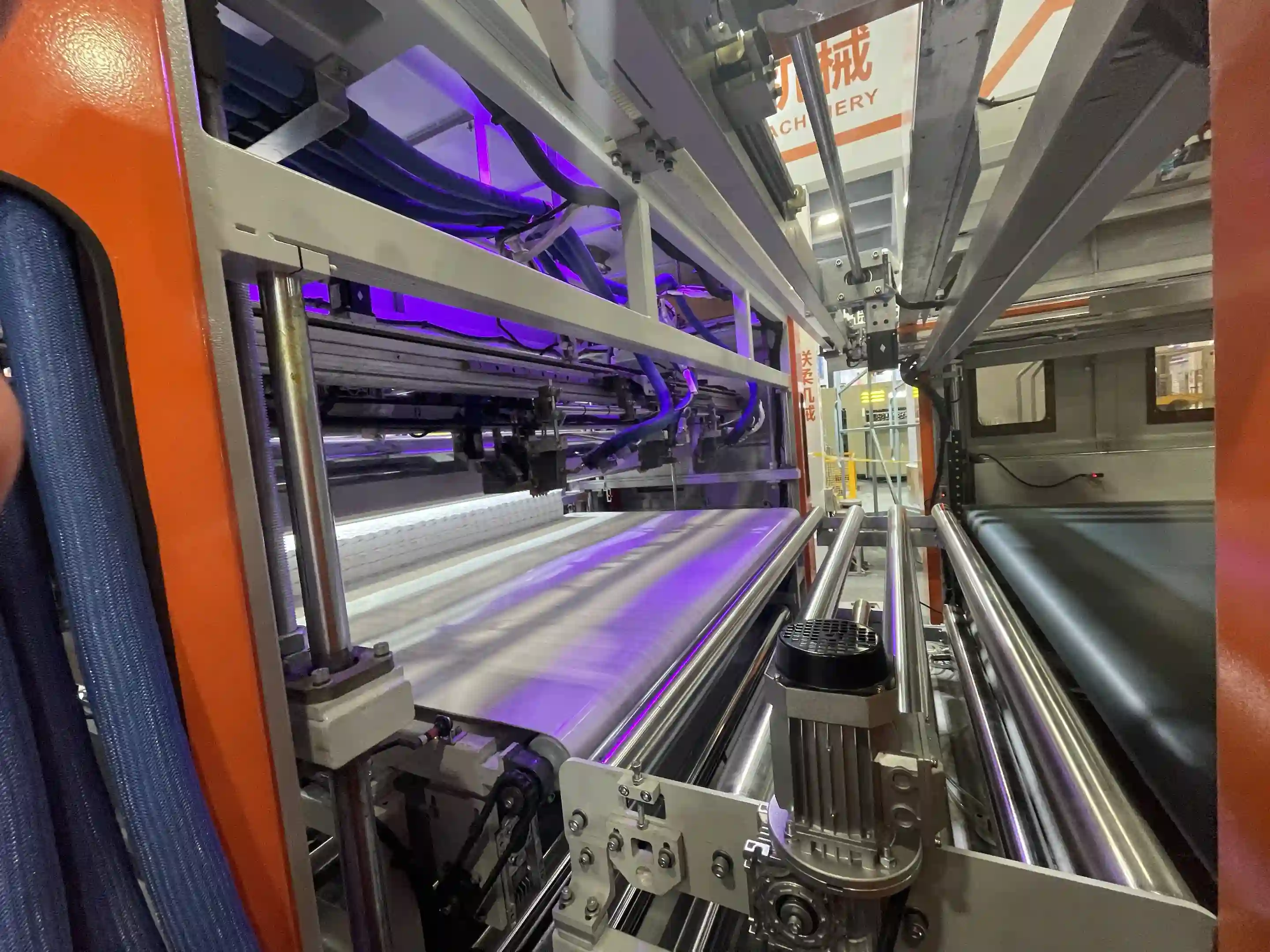
For small and medium-sized mattress manufacturers, or factories producing many mattress models in relatively small batches, completely eliminating manual loading may not be the most economical solution.
LianRou can therefore configure the equipment for manual comfort-layer loading. Operators place foam, latex, memory foam, or other comfort layers into the designated position, while the machine performs the subsequent adhesive application and lamination process.
This configuration allows manufacturers to automate the part of production that has the greatest impact on adhesive consumption and bonding consistency without immediately investing in a complete robotic loading system.
It is particularly suitable for factories pursuing gradual automation. A manufacturer can first install an automatic mattress gluing machine, then add mechanical assistance or robotic loading as production volume increases.
This approach gives mattress manufacturers greater control over their initial investment while retaining a clear path toward higher automation.
The second configuration uses a mechanical arm combined with an AI visual recognition system.
The mechanical arm handles material movement, while the AI vision system identifies the actual material position, orientation, and deviation. The visual information is then used to guide the mechanical arm in correcting the placement.
This configuration provides a practical balance between automation and equipment investment. Its mechanical structure is less complex than a six-axis robotic system, making it suitable for factories with relatively stable product specifications and a need to reduce manual material handling.
The mechanical arm has fewer degrees of freedom than a six-axis robot, but that does not mean it cannot perform the required positioning task.
According to LianRou's process evaluation, the movement range of the mechanical arm is sufficient for the typical angular deviations encountered in this application. It can therefore work with AI vision to identify and correct positioning deviations within the required operating range.
For large mattress factories or manufacturers planning a highly automated smart mattress production line, LianRou can configure a six-axis AI flexible loading composite robot.
A six-axis robotic arm provides a wider range of movement and greater rotational freedom, allowing it to pick up and place flexible materials such as foam, latex, and memory foam from different directions.
The process works through coordinated visual recognition and robotic movement.
First, the AI vision system identifies the actual position and orientation of the comfort layer on the preparation platform and converts the visual information into coordinate data.
Next, the pocket spring unit enters the bonding position through the conveyor system. The AI vision system identifies the actual coordinates and angular deviation of the spring unit.
The robot then compares the relevant positioning data and uses the pocket spring unit as the reference position to correct the comfort layer's deviation before completing the lamination process.
The mechanical arm and six-axis AI flexible loading robot therefore share the same fundamental logic:
AI vision identifies the deviation; the mechanical system performs the movement and correction.
The major differences are mechanical freedom, range of motion, flexibility, and investment level.
A six-axis robot is not automatically the right choice for every factory. A manufacturer with stable products and moderate production volume may find a mechanical arm more appropriate, while a large factory with many product configurations and long-term automation plans may benefit from the additional flexibility of a six-axis robot.
Configuration | Automation Level | Investment | Flexibility | Suitable For |
Manual loading | Basic automation | Lower | High | Small and medium factories, multiple SKUs |
Mechanical arm + AI vision | Medium-high | Medium | Medium | Stable mass production, controlled investment |
Six-axis AI robot + AI vision | High | Higher | High | Large factories, smart production lines |
These three configurations represent different investment strategies.
Manual loading provides the lowest initial investment and high flexibility when products change frequently. A mechanical arm offers a balance between labor reduction and equipment cost. A six-axis AI flexible loading robot provides greater movement freedom and is better suited to factories targeting higher levels of automation and future integration.
Therefore, when purchasing an automatic mattress foam gluing machine, manufacturers should not choose solely according to automation level. Production volume, SKU quantity, labor cost, product variation, factory layout, and future expansion should all be included in the investment calculation.
Zebra-type glue rolling refers to an intermittent or strip-based adhesive distribution pattern rather than continuous full-surface coating.
The visual pattern resembles zebra stripes, with adhesive applied in controlled lines across the bonding surface.
The basic principle is straightforward:
Apply adhesive where bonding is required instead of unnecessarily covering the entire surface.
For mattress comfort-layer lamination, properly designed adhesive lines can create sufficient bonding between layers while reducing unnecessary adhesive application.
LianRou integrates this rolling concept with the spraying system so manufacturers can select the appropriate application method according to their materials and mattress construction.
Spraying and rolling should not be viewed as a simple "either/or" decision.
Spraying is useful when manufacturers require flexible adjustment of adhesive coverage and application quantity. It can be particularly useful for factories producing different mattress specifications.
Rolling is useful when a regular strip-based adhesive pattern is preferred, especially in continuous production where controlling adhesive consumption is important.
A Mattress PUR Glue Spraying and Rolling Machine that supports both methods therefore provides a broader process range than a machine limited to a single adhesive application technology.
The appropriate method should ultimately be selected according to the actual mattress structure, material characteristics, adhesive specification, required bonding strength, and production target.
A typical mattress PUR bonding workflow can be organized as:
Pocket Spring Unit → Adhesive Application → Comfort Layer Positioning → Visual Alignment → Layer Lamination → Subsequent Pressing and Assembly
With manual loading, operators position the comfort layers while the machine performs adhesive application and bonding.
With a mechanical arm, material handling becomes partially automated and AI vision provides positioning information.
With a six-axis AI flexible loading robot, material handling, positioning, correction, and placement can be further automated.
The value of this production structure is not simply the elimination of one manual operation. It connects several repetitive actions into a controlled production sequence.
For large hybrid mattress factories, a stable production rhythm can make better use of downstream equipment and reduce interruptions caused by manual transfer between individual processes.
A common purchasing mistake is comparing only the maximum operating speed of individual machines.
In actual mattress manufacturing, effective production capacity is affected by material loading, comfort-layer dimensions, adhesive heating stability, positioning time, bonding time, manual handling, product changeover, and downstream processes.
Therefore, the fastest machine specification does not necessarily represent the highest daily output in a real factory.
LianRou's published information for its LR-TA-PE reference configuration indicates a production capacity of approximately 600 mattresses per day, depending on the actual product and configuration.
When purchasing high speed mattress PUR hot melt gluing equipment, manufacturers should therefore request a production test based on their actual mattress dimensions, materials, target output, and production cycle instead of comparing only theoretical machine speed.
LianRou's published reference model for its automatic mattress spraying and rolling equipment is LR-TA-PE.
Parameter | Reference Specification |
Model | LR-TA-PE |
Production Capacity | Approx. 600 mattresses/day |
Adhesive Application | Spraying + Rolling |
Spray Heads | 6 sets/unit |
Rolling Temperature | 140–160°C |
Control System | Servo Control |
Air Consumption | 0.1 m³/min |
Air Pressure | 0.6–0.7 MPa |
Total Power | 70 kW |
Voltage | 3AC 380V |
Frequency | 50/60 Hz |
Machine Weight | Approx. 10,000 kg |
Mattress Thickness | 50–350 mm |
Mattress Width | 900–2,100 mm |
Foam Density | 20–70 kg/m³ |
Foam Shape | Flat / Wave |
The final machine configuration should be confirmed according to the customer's actual mattress materials, adhesive specification, production requirements, and factory utilities.
For PUR bonding equipment, the adhesive specification should be confirmed before finalizing the machine configuration.
Different PUR hot melt formulations may have different melting temperatures, viscosities, open times, and curing characteristics. These parameters affect the heating system, pump, hoses, spray heads, and rolling system.
Manufacturers should therefore provide the actual adhesive technical data to the machine supplier.
At the same time, buyers should prepare actual production materials such as pocket spring units, foam, memory foam, latex, and mattress fabrics for testing.
Testing only a standard foam sample at a machinery showroom may not accurately represent the production conditions of the customer's factory.
The most reliable approach is an actual comparative production test.
Manufacturers can record adhesive consumption under different processes, including manual spraying, conventional continuous rolling, and LianRou's controlled spraying or zebra-pattern rolling modes.
The evaluation should include:
A 30%–40% reduction in adhesive consumption can only be evaluated economically when the factory knows its actual adhesive price and production volume.
A more meaningful ROI calculation is:
Glue saved per mattress × Daily mattress output × Adhesive cost per kilogram × Annual production days
This converts an equipment specification into an actual production-cost calculation.
Guangzhou Lianrou Machinery and Equipment Co., Ltd. has been engaged in mattress machinery research, development, and manufacturing since 1998. LianRou's public company information states that it has 28 years of manufacturing experience, serves customers in more than 150 countries, and has worked with more than 2,000 partners.
Its product range extends beyond pocket spring machines to include pocket spring assembly machines, mattress packaging equipment, mattress bonding equipment, and intelligent mattress production solutions.
This broader machinery background matters because a mattress PUR glue spraying machine is rarely an isolated production process. In a complete mattress factory, it may need to connect with a pocket spring production line, pocket spring assembly machine, foam processing equipment, mattress turning equipment, pressing equipment, and subsequent packaging processes.
LianRou's published customer information also references international mattress and furniture companies including IKEA, Sealy, Serta, Simmons, and Yalan.
These references demonstrate LianRou's experience in the mattress machinery industry; they should not be interpreted as a claim that every named company uses the specific PUR laminating machine described in this article.
For a mattress factory already producing pocket spring units, a typical upgrade path is to use the pocket spring unit as the support core and add foam, memory foam, latex, or other comfort layers above it.
The Mattress PUR Assembly Line then performs controlled adhesive application and layer bonding.
A factory currently using manual loading can begin with an automatic spraying and rolling system. As production volume increases, a mechanical arm can be added. For factories targeting a highly automated Smart Mattress Production Line, the process can be upgraded further with a six-axis AI flexible loading composite robot.
This staged approach allows manufacturers to increase automation without necessarily making the entire investment at once.
Before installation, the factory should confirm floor space, equipment access routes, electrical capacity, compressed air, adhesive storage and supply conditions, machine orientation, upstream and downstream equipment interfaces, and operator access.
For a reference configuration with approximately 70 kW total power, the factory's electrical infrastructure should be checked against the final machine specification.
The exact machine dimensions, weight, power requirements, and utility requirements should always be confirmed in the final technical agreement.
Because PUR adhesive systems are process-sensitive, operators should also receive training in heating-system operation, adhesive supply, spray-head maintenance, rolling-system operation, shutdown procedures, and routine cleaning.
The maintenance of PUR equipment involves more than mechanical lubrication. Adhesive-system stability is equally important.
Operators should follow the adhesive manufacturer's and machine manufacturer's procedures for temperature management, shutdown, cleaning, and adhesive-line maintenance. Residual adhesive can cure inside components if the equipment is not handled according to the required process.
For exported machinery, after-sales support is particularly important because downtime in an automated mattress line can affect the production rhythm of several connected processes rather than just one machine.
LianRou provides installation, commissioning, operator training, and technical support as part of its machinery service system.
It is an automated mattress bonding machine that combines PUR adhesive application, spraying, rolling, and layer lamination. It can be used to bond pocket spring units with foam, latex, memory foam, comfort layers, and other mattress materials.
Yes. Hybrid mattresses combine a coil-based support core with substantial comfort layers, making controlled multi-layer bonding an important production process. Pocket springs, foam, memory foam, latex, and microcoils are among the materials commonly used in hybrid mattress construction.
Spraying applies adhesive through spray heads and provides flexible control over the application area and quantity. Rolling uses a mechanical roller to create controlled adhesive lines. LianRou combines both methods in one mattress bonding system.
Yes, provided that the final machine configuration is matched to the specific PUR adhesive. Different PUR formulations can have different melting temperatures, viscosities, open times, and curing requirements, so the adhesive technical data should be confirmed before equipment configuration.
LianRou's published product information indicates an average adhesive saving of approximately 30%–40% for its controlled spraying and rolling solution. Actual consumption depends on the adhesive, mattress materials, product dimensions, application pattern, and production settings.
It can be configured for different mattress comfort materials, but the exact bonding process should be verified according to material density, surface characteristics, thickness, adhesive formulation, and required bonding strength. Actual material testing is recommended before final equipment selection.
No. The system can be configured for manual loading, mechanical-arm loading with AI vision, or six-axis AI flexible loading and composite robotics. The appropriate configuration depends on production volume, labor requirements, product variety, and investment objectives.
Not necessarily. A six-axis robot provides greater movement freedom, rotation, and positioning flexibility, making it suitable for complex products and higher automation levels. A mechanical arm has lower mechanical complexity and investment requirements while still being capable of correcting positioning deviations within the applicable operating range when combined with AI vision.
LianRou's published LR-TA-PE reference configuration has a production capacity of approximately 600 mattresses per day. Actual output depends on mattress dimensions, materials, production cycle, and machine configuration. Final capacity should be confirmed through a production test using the customer's actual mattress products.
The decision should consider daily production volume, hybrid mattress construction, comfort-layer materials, labor costs, SKU quantity, factory layout, adhesive consumption, and future expansion plans.
Factories seeking lower initial investment can choose manual loading. Manufacturers looking for a balance between automation and investment can consider a mechanical arm with AI vision. Factories targeting a highly automated smart mattress production line can consider a six-axis AI flexible loading composite robot.


TOP
