Qu'est-ce qu'une machine à enrouler les ressorts ? Un guide complet pour les industries du matelas et du meuble

Date:

With the global mattress and upholstered furniture industries shifting toward automation and smart manufacturing, mattress manufacturers and furniture factories are focusing heavily on production efficiency, quality control, and manufacturing costs. In any mattress or seating system, the spring unit serves as the core component determining comfort, support, and durability. The specialized equipment behind these high-performance components is the spring coiling machine (or pocket spring coiling machine).


Whether producing high-end pocket spring mattresses, hotel bedding, adjustable beds, functional sofas, or upholstered furniture, quality spring systems are essential. Consequently, the spring coiling machine is not just a standalone piece of mattress machinery—it is the foundational heartbeat of the entire pocket spring production line.


This comprehensive guide breaks down how spring coiling machines work, their diverse industry applications, technical buying advice, and how they help manufacturers scale their business.


What is a Spring Coiling Machine?


A spring coiling machine is an automated industrial system engineered to transform high-carbon steel wire into precision-crafted mechanical springs. Utilizing advanced CNC control systems and servo-drive technology, the machine orchestrates a continuous production sequence: automatic wire feeding, coiling, heat treatment, compression, and cutting.

By automating these steps, it ensures each spring maintains strict uniformity in height, coil count, diameter, and rebound force. This equipment produces pocket springs, Bonnell springs, and various specialized spring structures. For pocket springs, the coiled wire is seamlessly enclosed within non-woven fabric pockets, creating independent pocket spring strings that form the core of modern mattresses and sofas.


Spring Coiling Machine vs. Pocket Spring Machine: What’s the Difference?


  • Spring Coiling Machine: Strictly speaking, this term refers to the machine that handles the initial spring-forming and coiling stage.


  • Pocket Spring Machine: This is a more integrated system that combines coiling, heat treatment, compression, and fabric pocket wrapping into a single, seamless operation.


Because modern high-speed equipment typically integrates all of these processes, industry professionals frequently use the two terms interchangeably.


Step-by-Step: How Does a Pocket Spring Machine Work?


Modern pocket spring machines are highly intelligent, all-in-one manufacturing systems. From raw steel wire to finished, continuous pocket spring rows, the entire process is fully automated to guarantee maximum throughput and product consistency.


[Wire Feeding] ➔ [CNC Spring Coiling] ➔ [Heat Treatment] ➔ [Compression & Pocket Inseration] ➔ [Ultrasonic Welding] ➔ [Automatic Cutting]


1. Wire Feeding System

The process begins with high-carbon steel wire mounted on a payoff reel, which is fed smoothly into the machine via an automatic de-coiling device. High-speed machines use high-precision servo feeding systems equipped with real-time tension monitoring and automatic straightening tech. This prevents tension fluctuations from altering spring dimensions, eliminating material waste even when running at extreme speeds like 180 springs per minute.


2. CNC Spring Coiling System

Once the wire enters the coiling zone, CNC systems and servo motors drive the tool tooling mechanisms to shape the wire based on pre-programmed parameters. The machine precisely manages coil diameters, total height, turns, and wire gauges. This adaptability allows manufacturers to produce a wide range of spring geometries, including:
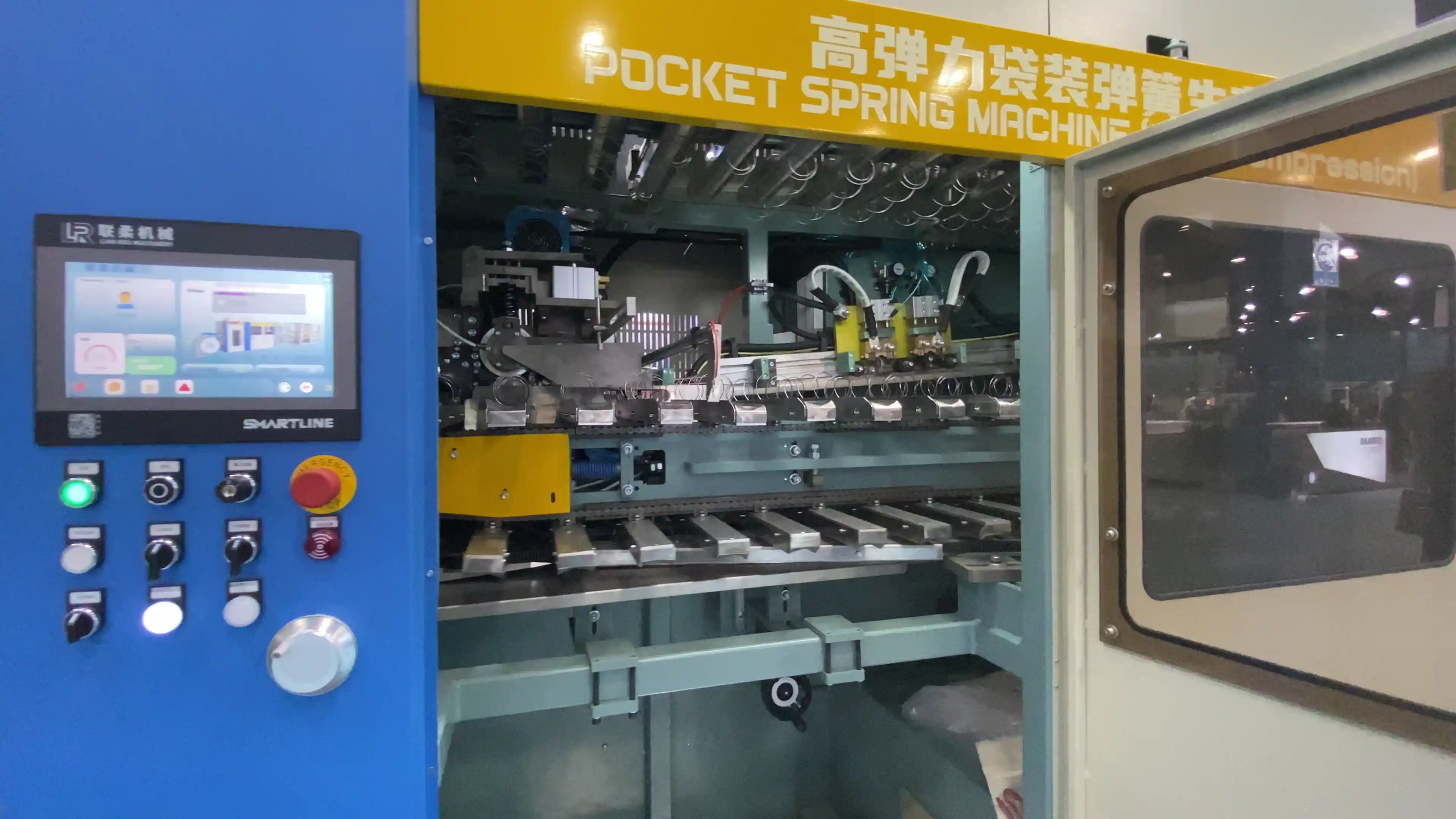

  • Cylinder Springs
  • Barrel Springs
  • Hourglass Springs
  • Zoned Springs
  • High-Compression Sofa Springs


3. Integrated Heat Treatment

Why is "Pocket Spring Machine with Heat Treatment" a mandatory spec for global buyers? Coiling steel wire induces massive internal mechanical stress. Without immediate relief, the springs will suffer from premature deformation, fatigue, or breakage over time. The integrated thermal treatment system precisely controls temperature and duration to eliminate these stresses, delivering exceptional rebound memory, high fatigue resistance, and extended product lifespans.


4. Compression and Ultrasonic Pocketing

After thermal stabilization, the spring is mechanically compressed to its target height and pushed into a forming non-woven fabric sleeve. The pocket is then sealed using ultrasonic welding technology. Ultrasonic sealing is the gold standard for high-speed lines because it provides incredibly strong bonds, uses minimal energy, and operates at rapid cycle times.


5. Automatic Cutting and Output

Finally, the machine tracks the count and length of the pocketed spring string. Once the preset configuration is met, an automated cutting blade cleanly separates the string. The finished pocket spring rows are continuously fed forward, ready for the next phase of assembly.


Why Pocket Springs are the Core of Mattress and Sofa Factories


The global bedding and seating industries have experienced a massive paradigm shift from interconnected network springs (like Bonnell) to independent pocket springs.


For Mattress Manufacturers:


  • True Ergonomic Support: Because each pocket spring moves independently, the mattress conforms precisely to the individual pressure exerted by the shoulder, waist, and hips, keeping the spine naturally aligned.


  • Zero Motion Transfer: When one person rolls over, the energy dispersion is localized. This eliminates partner disturbance, a massive selling point in the premium consumer and hospitality markets.


  • Enhanced Breathability: The open nature of an independent spring core creates massive air pathways, dissipating heat and keeping the mattress fresh.


For Upholstered Furniture Manufacturers:

Traditional sofa construction relies on high-density foam or zigzag springs, which are highly prone to sagging, permanent compression deformation, and localized structural fatigue.


  • Incorporating pocket spring units into luxury sofas delivers superior, long-lasting resilience and ergonomic weight distribution.
  • Furthermore, pocket-sprung seating elements handle roll-packing and heavy compression beautifully. This makes them highly suitable for direct-to-consumer (DTC) e-commerce brands and high-volume furniture exporters looking to slash shipping costs.


The High-Compression Sofa Spring Revolution: Historically, pocket springs maxed out at around 35cm in height, meaning sofa makers had to stack multiple layers of spring units to build full-scale seating bases. Thanks to innovations from industry leaders like LianRou Machinery, specialized high-compression pocket spring machines can pre-compress a 50cm-tall spring down to a 35cm pocket with a 100% compression ratio. LianRou’s latest advancements even enable pocket springs up to 60cm tall, completely replacing traditional solid wooden or heavy metal sofa bases, dropping material costs significantly, and fundamentally changing how upholstered furniture is engineered.


The Anatomy of a Modern Pocket Spring Production Line


Investing in standalone machinery is rarely enough for a scaling factory. To maximize efficiency, a complete pocket spring production line operates from raw materials to final packaging through integrated stages:


· Component Production: Pocket Spring Machine transforms steel wire and non-woven fabric into pocket spring strings.

· Core Assembly: Pocket Spring Assembly Machine uses automated hot-melt glue patterns to join spring strings into multi-zone innersprings (3-zone, 5-zone, 7-zone, etc.).

· Comfort Layering: Mattress Cotton Layer Gluing Machine, automatically applies and bonds comfort materials like latex, memory foam, or PU foam to the spring core.

· External Sewing: Mattress Tape Edge Machine, automatically flips and sews the quilted decorative panels and border fabrics together to seal the mattress.

· Logistics Optimization: Mattress Compression & Roll-Packing Machine, Compresses, vacuum-seals, and roll-packs the finished mattress, shrinking its volume by over 50% for optimal shipping.


Buying Advice: How to Choose the Right Spring Coiling Machine


When auditing mattress machinery suppliers, avoid focusing solely on the initial price tag. Assess these critical operational parameters:


  • Production Speed & Scalability: Machine throughput varies wildly—ranging from 120 to 180 springs per minute, up to ultra-high-speed configurations. Mid-to-large-scale mattress manufacturers should aim for high-speed machinery capable of 200 to 280+ springs per minute to lower per-unit labor costs and accommodate future business expansion.


  • Product Versatility & Flexibility: The market demands product variety. Ensure your selected machine offers quick parameter adjustments via CNC to switch between different wire gauges, spring heights, barrel profiles, zoned spring patterns, and high-compression setups without extensive down-time.


  • Heat Treatment Reliability: Confirm the machine uses a premium pre- or post-coiling thermal treatment system. Precise heating curves prevent pocket tearing and dictate the overall mechanical consistency of your output.


  • Industry 4.0 Integration: Look for systems boasting advanced CNC control, multi-axis servo configurations, and remote diagnostics. Remote monitoring minimizes downtime by allowing off-site engineers to troubleshoot software glitches instantly.


Future Trends in Spring Coiling Technology


As Manufacturing 4.0 matures, pocket spring machines are evolving rapidly across four key pillars:


  • AI-Driven Production: Integration of artificial intelligence for real-time defect detection, predictive maintenance notifications, and self-adjusting tension controls to hit perfect consistency.


  • Extreme Throughput: Emerging ultra-high-speed mechanical architectures are pushing production benchmarks past 250+ springs per minute.


  • Green Manufacturing: Engineering focused on energy-efficient servo recovery loops and zero-waste material cutting to lower carbon footprints and operational power consumption.


  • Enterprise Synchronization: Deep API integration linking the pocket spring machine's onboard software directly with factory ERP and MES systems for fully automated inventory and order fulfillment.


FAQ: Frequently Asked Questions


1. Can a single spring coiling machine make both mattress and sofa springs?

Yes, provided the machine features a versatile CNC control system and a wide mechanical tolerance range. Advanced machines can easily switch parameters to handle the thicker wires and high-compression profiles typical of sofa springs, alongside traditional mattress configurations.


2. Why is ultrasonic welding preferred over traditional sewing for pocket springs?

Ultrasonic welding utilizes high-frequency acoustic vibrations to melt the synthetic fibers of non-woven fabric together instantly. It requires no consumables (like thread or needles), operates at significantly higher speeds, uses less energy, and yields a structurally superior weld that will not unravel under heavy loads.


3. What maintenance does a high-speed pocket spring machine require?

Daily routines involve clearing out metal dust particles and verifying wire alignment guides. Weekly/monthly checks should focus on lubricating mechanical joints, assessing ultrasonic horn wear, and checking the performance of the heat treatment heating elements to ensure uniform heat distribution.


Partner with a Trusted Global Leader


Selecting the right spring coiling machine is the single most important infrastructure decision for determining product quality and long-term profit margins. As a premier manufacturer of advanced mattress machinery, LianRou Mattress Machinery delivers state-of-the-art spring coiling systems, high-speed pocket spring machines, and fully automated turn-key production lines. Designed to lower labor overhead, eliminate material waste, and maximize throughput, LianRou helps factories around the world transition seamlessly into modern, sustainable automated manufacturing.

Spécifications techniques : Mécanismes de production avancés des ressorts ensachés Pour les fabricants de matelas internationaux évaluant leurs investissements dans des machines de production, il est primordial d'allier une production automatisée à une intégrité structurelle métallurgique irréprochable. Les systèmes d'enroulement mécanique traditionnels rencontrent souvent des problèmes de débit et de régularité lors de la manipulation de fils de diamètres variés. Les machines modernes à ressorts ensachés CNC résolvent ces limitations grâce à une synchronisation servo multiaxes intégrée. Cette infrastructure permet un ajustement en temps réel du système d'alimentation en fil, garantissant ainsi une tension optimale du fil d'acier à haute teneur en carbone à l'entrée de l'outil d'enroulement. Par conséquent, les écarts dimensionnels des ressorts cylindriques, des ressorts à barillet et des structures de soutien zonées sont réduits au millimètre près, assurant une force de rebond uniforme même lors de cycles de production à haut volume. #### Optimisation métallurgique par traitement thermique en ligne Un atout majeur pour les fabricants de meubles rembourrés haut de gamme et les producteurs de matelas industriels réside dans l'utilisation d'une machine à ressorts ensachés avec traitement thermique. Le procédé d'enroulement à froid, inhérent à la fabrication rapide de ressorts, induit des contraintes cinétiques importantes et des déformations localisées dans le réseau de fils d'acier à haute teneur en carbone. Si ces contraintes mécaniques ne sont pas prises en compte, l'âme du ressort fini subira une fatigue structurelle catastrophique et un affaissement localisé sous des charges dynamiques soutenues. Le système de stabilisation thermique intégré aux machines d'enroulement de ressorts à grande vitesse soumet chaque spire à un processus de chauffage par résistance électrique ou par induction, contrôlé avec précision. Ce recuit instantané recalibre la structure cristalline interne de l'acier, optimisant ainsi sa mémoire de forme, augmentant sa résilience à la traction et prolongeant la durée de vie du ressort ensaché. Ce procédé est essentiel pour répondre aux normes internationales de durabilité de la literie commerciale, exigées par les marques hôtelières haut de gamme et les marchés du meuble destinés à l'exportation. #### Scellage ultrasonique des poches en non-tissé et intégration de l'assemblage À la sortie de la phase de stabilisation thermique, le ressort mécanique est fortement comprimé et guidé sans interruption dans la zone d'alimentation de la gaine en tissu non tissé continu. L'intégrité de chaque poche de ressort est préservée grâce à des systèmes de soudage ultrasonique automatisés. Contrairement aux méthodes de collage obsolètes ou aux techniques de couture mécaniques traditionnelles, le collage ultrasonique utilise la friction acoustique à haute fréquence pour souder directement, au niveau moléculaire, les fibres thermoplastiques synthétiques du textile non tissé. Il en résulte une liaison moléculaire d'une résistance exceptionnelle, capable de supporter des pressions internes extrêmes sans se déchirer ni s'effilocher. Pour les usines de matelas automatisées souhaitant adopter les paradigmes de l'Industrie 4.0, le flux de travail s'étend directement de la machine à enrouler les ressorts ensachés à la machine d'assemblage. Cette ligne d'assemblage intégrée utilise des applications de colle thermofusible programmables pour fusionner les rangées de ressorts ensachés en réseaux complexes, zonés anatomiquement. Grâce à la synchronisation des systèmes d'alimentation à double fil, les machines modernes de fabrication de matelas peuvent alterner automatiquement le diamètre des fils au sein d'une même chaîne continue, produisant ainsi des matelas multizones adaptés à une répartition ergonomique de la pression. Cette méthodologie intégrée élimine les goulots d'étranglement lors de l'assemblage manuel en aval, optimise l'utilisation des matières premières et réduit considérablement les coûts de production unitaires de l'usine.

TOP

Contact Us
Contact Us: +86 189 2629 2610
E-Mail
E-Mail: inquiry@lianrou.com
WeChat
TOP