지능형 매트리스 기계
150개국 이상 수출
Date:
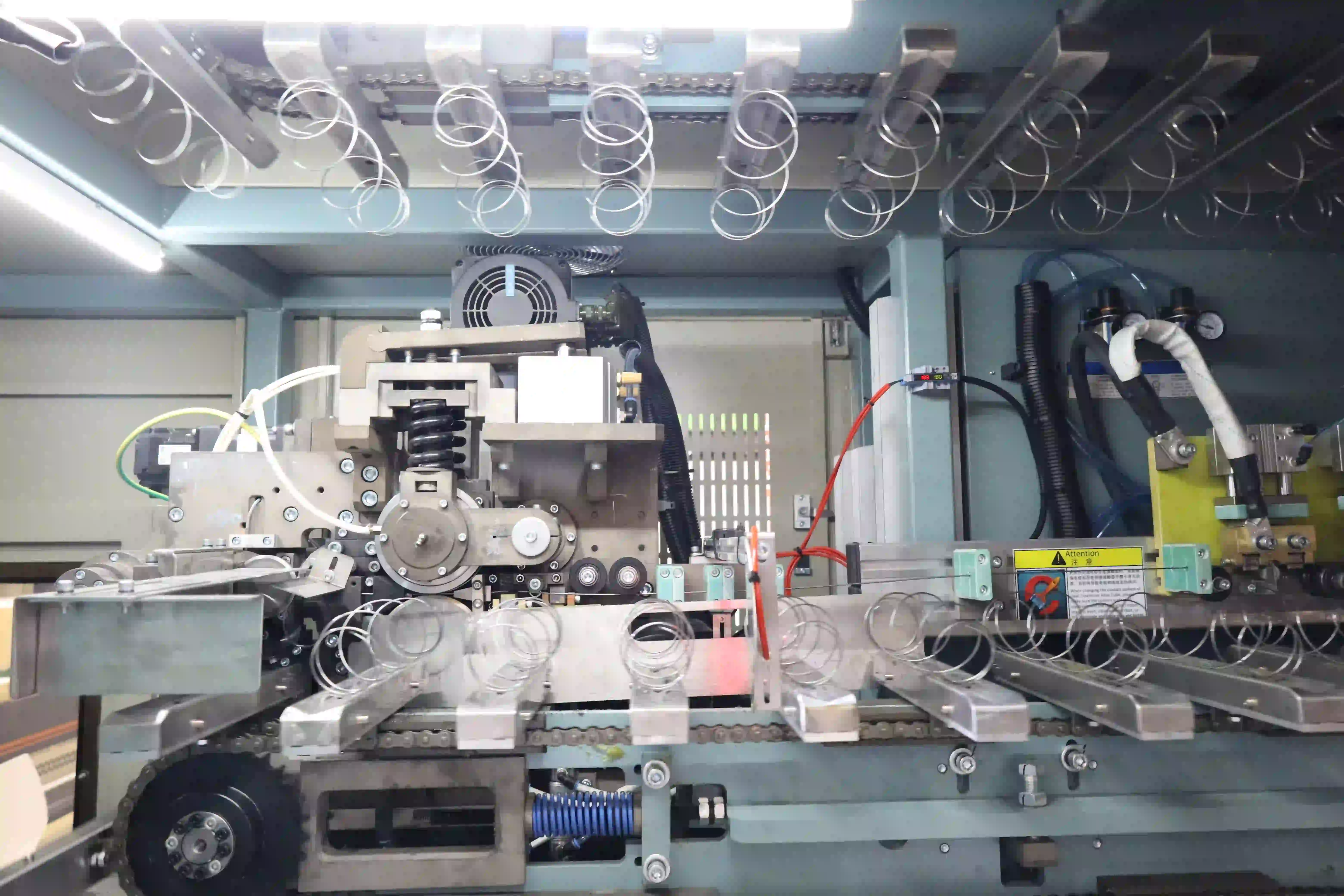
A pocket spring machine (also called a pocket coil machine or pocket spring assembly machine) manufactures mattress springs by feeding high-carbon steel wire through a coiling head that forms individual coils to a preset diameter, pitch, and height; The springs are cooled by the spring conveyor seat to ensure that the bags are not damaged by heat; a non-woven fabric feeding unit wraps the coil in fabric; Finally, ultrasonic technology is used to seal both ends of the bag, and an automatic counting and cutting device is used to connect the packaged bag springs into a continuous spring strip. These strings are later assembled into a full pocket spring unit on a pocket spring assembly machine, ready for foam lamination and mattress or sofa cushion assembly.
The core pain points mattress factories, bedding manufacturers, and sofa factories face are threefold: inconsistent coil quality causing customer complaints and returns, low production speed that cannot meet order volume, and machines that cannot be adapted to different spring counts, firmness levels (soft/medium/firm), or coil diameters used across product lines. The solution is a properly engineered, custom-made pocket spring production line — one where coiling accuracy, wire tension control, non-woven fabric width, and hot-melt gluing temperature are all matched to your specific mattress or sofa spring specification. This article explains the full production process in scientific and mechanical detail, compares pocket spring machines against Bonnell spring machines, provides real equipment parameters, and gives a step-by-step procurement framework so factory owners and purchasing managers can evaluate any bedding machine supplier — including LianRou Mattress Machinery — with confidence.
• The pocket spring machine processes raw spring steel wire into individually pocketed springs through four mechanical processes: spring winding, non-woven fabric wrapping, and gluing.
• Pocket coils (wrapped coils) were invented by Canadian engineer James Marshall, who patented the design in Canada in 1900 and in the US and UK in 1901–1902, making it the historical foundation of modern independent-coil mattress technology.
• Pocket spring machines differ fundamentally from Bonnell spring machines: pocket spring units use individually encased coils for motion isolation, while Bonnell springs are open, hourglass-shaped, and interconnected by helical wire for lower cost and firmer support.
• Production speed, wire diameter range, coil height range, and non-woven fabric compatibility of pocket spring machines are the four specifications every mattress factory should verify before purchasing a pocket spring production line.
• Custom-made machines let sofa factories and mattress manufacturers switch between multiple coil diameters, pocket shapes (cylindrical, dual-density, offset), and spring counts on a single production line.
• After-sales response time, spare parts availability, and installation/training support are as important as machine price when selecting a mattress machine manufacturer.
Pocket springs, also known as individually wrapped coil springs, differ from older integrated spring systems. Each spring moves independently within a pocket, responding only to pressure applied directly above it, unaffected by the movement of adjacent springs or other areas of the mattress or sofa cushion. This is how pocket springs maintain a precise fit to the body, unaffected by a partner's movements.
According to the Wikipedia entry for "Marshall coil," the pocket spring was invented in 1899 by Canadian-born mechanic James Marshall, who obtained a Canadian patent in 1900, followed by patents in the United States and the United Kingdom. Marshall pre-compressed the springs, hand-sewing each spring into an individual cotton bag. These individual pocket springs were then sewn into spring strips, which were then combined and arranged to form a pocket spring support system. This is the technological origin of the pocket spring machine; the production principle has remained unchanged, only evolving from hand-sewing to a servo-driven, fully automated spring winding and assembly production line.
For a mattress to be truly comfortable, the key is providing appropriate support to every part of the body, regardless of weight. For example, the hips, which are heavier, should be supported by springs with thicker wire diameters, while the feet, which are lighter, should be supported by springs with thinner wire diameters. Simply put, the pressure distribution of the human body is curved, and the support level is not uniform. The one-piece Bonnell spring structure cannot provide zoned support, while pocket springs can customize support based on the body's pressure curve, scientifically and precisely conforming to the body's sleep needs. Therefore, pocket springs are commonly used in mid-to-high-end mattresses, while Bonnell springs are found in mid-to-low-end mattresses.
Pocket springs offer shock absorption (anti-interference, quiet turning), conform to the body's curves, and allow the use of different wire diameters in different areas. This allows for scientifically designed zoning of the mattress based on the body's weight distribution, requiring the combined production of pocket springs and gluing machines. The Bonnell spring system remains popular to this day, generally used to create mattresses with firmer support because its open, interconnected structure is simpler to manufacture mechanically, and its mass production cost is suitable for mattress factory owners who are just starting out.
The entire production process begins with the selection of high-carbon steel wire, typically with a wire diameter between 1.6mm and 2.4mm. The thicker the wire, the firmer the mattress core. The steel wire is fed from the wire rack, passes through a straightening device, and then enters the winding mechanism of the pocket spring machine. This winding mechanism is usually driven by a servo motor, winding the steel wire onto a mandrel. Based on the system-set spring waist diameter (commonly ranging from 30mm to 55mm), number of turns, and turn spacing, a single spring is wound. The height of the spring after pocketing is set according to the mattress or cushion thickness requirements. Common mattress thicknesses range from 25mm to 35mm, while sofa cushions are lower, typically ranging from 4mm to 18mm. Lianrou Machinery's floor-standing semi-finished spring sofas can achieve a pocket height of 60mm. The spring winding precision directly determines the consistency of the finished spring product. If there is uneven turn spacing or spring misalignment among thousands of springs, it will cause uneven mattress firmness.
High-speed pocket spring machines synchronize this cutting action with the coiling head so that hundreds of coils per minute can be produced without wire deformation at the cut point, which would otherwise create a sharp edge that punctures the fabric pocket or the mattress cover during use.
The molded springs are fed into a non-woven fabric encapsulation bag mechanism. The non-woven fabric combines breathability, tear resistance, and hot-melt adhesive bonding. As the springs pass through the equipment, mechanical guides fold the fabric to cover them. The fabric width must precisely match the spring diameter: too loose and the springs will shift inside the bag; too tight and the springs' range of motion will be restricted, thus reducing the mattress's support performance.
Ultrasonic welding is a crucial step in the process. It involves both sealing individual springs in bags and welding individual bagged springs into continuous spring strips.
An automatic counting sensor records the number of packaged springs and automatically cuts them when the target number of springs per string is reached (depending on subsequent assembly requirements). The completed bagged spring strings are then fed directly into the Pocket Spring Assembly Machine via a spring feeding trolley for core assembly.
Pocket spring assembly machines arrange multiple parallel spring strings into a spring pack the width of a full mattress or sofa and glue the fabric edges of adjacent spring strings together to form an interconnected, complete pocket spring mattress/sofa core. Different assembly machines vary greatly in the number of spring strings that can be aligned simultaneously, as well as the precision of controlling the spacing between the spring strings, which directly affects the firmness and softness zoning effect of the finished mattress.
Most fully automatic bag spring assembly machines support the production of zoned bed nets. By using the double-line machine of the bag spring production machine, two different diameter bag spring strips can be produced simultaneously. Then, the spring strips of different diameters are fed into different feeding channels of the bag spring gluing machine to be bonded into bed nets with different soft and hard zones.
Mattress and sofa factory owners often ask whether they need a pocket spring machine, a Bonnell spring machine, or both. The market demand for these two types of springs differs, and the required equipment is completely different.
A Bonnell spring is an hourglass-shaped open spring, consisting of a single continuous steel wire spiral connecting adjacent springs to form an interconnected mesh structure. A Bonnell spring machine completes the winding, knotting, and interconnection of the springs in a single continuous process, without any non-woven fabric covering or gluing. Therefore, the equipment structure is simpler, and the production cost of the finished springs is lower. Bonnell springs are widely used in economy mattresses, some sofa bed mechanisms, and mattress cores requiring firmer support because their interconnected structure effectively resists sagging under long-term weight.
A pocket spring machine requires additional non-woven fabric covering and gluing processes. Each spring moves independently without affecting adjacent springs. This increases production complexity and cost, but it results in superior shock absorption, more precise body contouring, and the ability to adjust the firmness of individual areas on a single mattress—product characteristics increasingly valued in the global mid-to-high-end bedding market. For factories that operate both economy and high-end product lines, most mattress machinery manufacturers, including Lianrou Mattress Machinery, supply both pocket spring production lines and Bonnell spring machines.
Sofa factories often face pocket spring configuration requirements that differ significantly from standard mattress specifications. For example, seat cushions typically require smaller coil diameters and shorter spring heights, and may need different spring densities between the front and rear sections of the cushion to achieve ergonomic zoned support. To address these needs, a Custom Made Machine allows these parameters to be incorporated into equipment engineering from the design stage itself, rather than forcing factories to compromise product design by adapting to off-the-shelf standard equipment.
Custom engineering typically covers the following key aspects:
·Spring Specifications: Including coil diameter range, wire gauge, spring height, etc.
·Pocket Design Options: Choose from standard cylindrical shape, offset (Bonnell-type), or dual-density zoned pockets that combine two wire gauges within a single spring to achieve zoned support.
·Programmable Spring Count per String: The number of springs per pocket string can be programmed according to sofa cushion dimensions.
·Non-Woven Fabric Compatibility: Adaptable to special breathable fabrics or antibacterial materials, meeting factory requirements for functional coverings.
Additionally, the custom pocket spring machine can be seamlessly integrated with the factory's existing foam lamination or sewing production lines, avoiding costly production line reconfiguration expenses. For mattress or sofa factories planning to expand into premium zoned support product lines, we recommend discussing custom tooling options with the supplier at the quotation stage itself, rather than waiting until after equipment installation. Retrofitting a standard machine afterward to accommodate new spring geometries will cost significantly more than proper planning from the very beginning.
Purchasing a pocket spring production line is a capital investment that typically runs into six figures (USD) for a full line, including coiling, gluing, and assembly units, so due diligence matters. Mattress factories and sofa factories should evaluate suppliers against the following criteria:
1. Verify actual production speed with your materials. Ask for a video test run using your specific wire gauge and non-woven fabric, not the supplier’s demo materials, since speed and coil consistency vary by material.
2. Confirm the control system and changeover time. A PLC-based touchscreen system should allow you to switch coil diameter, height, and spring count without manual retooling — ask how many minutes a changeover takes.
3. Request the machine’s actual defect rate under sustained operation, not just peak speed, since factories care about consistent output over an 8-hour shift, not burst performance.
4. Check spare parts lead time and local support, especially for wear components like cutting blades, glue nozzles, and coiling mandrels, which need regular replacement.
5. Ask for reference factories already running the same model, ideally in a similar product category (mattress vs. sofa cushion).
6. Compare total cost of ownership, not just machine price — factor in wire and fabric consumption efficiency, energy use, and maintenance frequency.
7. Confirm CE or equivalent safety certification and electrical compliance for your country’s factory regulations.
8. Clarify installation, training, and warranty terms in writing before signing, including who covers travel costs for on-site commissioning.
A mid-size mattress factory operating two manual assembly lines was producing approximately 1,800 mattresses per month but faced rising labor costs and inconsistent coil quality that led to a noticeable increase in warranty claims related to sagging and uneven firmness. After evaluating multiple pocket spring machine manufacturers, the factory selected a custom-made pocket spring production line configured for two coil diameters (39mm and 45mm) to serve both their standard and firm-support product lines from a single machine.
The new line was specified with servo-driven coiling for tighter pitch tolerance, a dual-nozzle gluing system to reduce seam failures, and a changeover time under 20 minutes between coil diameters. Within the first three months of operation, the factory reported a measurable reduction in warranty claims related to spring sagging, attributed to more consistent wire tension control during coiling, and increased monthly output capacity without adding a second shift. This outcome illustrates the core purchasing principle for mattress factories: production speed alone does not solve quality problems — coiling precision, gluing consistency, and changeover flexibility together determine whether a pocket spring machine delivers a real return on investment.
Machine uptime directly affects order fulfillment, so after-sales terms deserve the same scrutiny as technical specifications. A reliable mattress machine manufacturer should provide remote diagnostic support for PLC and servo systems, a documented spare parts catalog with published lead times, on-site or video-based installation training for factory technicians, and a defined warranty period (commonly 12–24 months on core mechanical components). Factories operating in regions distant from the manufacturer’s home country should specifically ask about regional service partners or remote troubleshooting capability, since extended downtime on a pocket spring production line has a direct, compounding cost on order fulfillment.
How does a pocket spring machine work? A pocket spring machine coils steel wire into individual springs, cuts each coil to length, wraps it in non-woven fabric, seals the fabric pocket using a hot-melt gluing system, and joins the wrapped coils into continuous strings ready for assembly into a full mattress or sofa spring unit.
What is the difference between a pocket spring and a Bonnell spring? A pocket spring is individually wrapped in fabric and moves independently of neighboring coils, providing motion isolation and body contouring. A Bonnell spring is an open, hourglass-shaped coil interconnected with adjacent springs by helical wire, offering firmer, lower-cost support without independent movement.
How much does a pocket spring production line cost? Cost varies significantly based on production speed, level of automation, and customization (coil diameter range, dual-density zoning, non-woven fabric compatibility). Factories should request itemized quotations covering coiling, gluing, and assembly units separately, along with installation and training costs, to compare suppliers accurately.
Can one machine produce different coil diameters and spring counts? Yes, when specified correctly. Modern PLC-controlled pocket spring machines allow programmable changeovers between coil diameters, heights, and spring counts per string, and custom-made machines can be engineered specifically for factories running multiple product lines.
What wire diameter is used for mattress pocket springs? Typical wire diameters range from 1.6mm to 2.4mm, with thicker wire producing firmer support and thinner wire producing a softer feel, adjustable within the same machine depending on the coiling head specification.
How do I choose between a standard and custom-made pocket spring machine? If your factory produces a single, consistent product specification, a standard configuration is usually more cost-effective. If you produce multiple firmness tiers, sofa and mattress products, or zoned-support designs, a custom-made pocket spring machine avoids the cost and downtime of retrofitting later.
What after-sales support should I expect from a pocket spring machine manufacturer? Expect a defined warranty period on mechanical components, documented spare parts availability, installation and operator training, and remote or on-site technical support for PLC and servo system troubleshooting.
Producing consistent, high-quality pocket springs depends on the precise coordination of five mechanical stages: wire coiling, cutting, non-woven fabric wrapping, hot-melt gluing, and string assembly. Understanding this process equips mattress factories, bedding manufacturers, and sofa factories to evaluate any pocket spring machine, pocket coil machine, or full pocket spring production line on technical merit rather than price alone. Whether sourcing a standard configuration or a custom-made pocket spring assembly machine, factories that verify real production parameters, request reference customers, and confirm after-sales terms in writing are best positioned to select equipment that performs reliably at scale — the same principles LianRou Mattress Machinery applies when engineering bedding machines for mattress and sofa manufacturers worldwide.


TOP
