A full set of intelligent mattress machinery industry brands
Mattress machines are exported to 150+ countries
Date:2026-06-26
With the global mattress and upholstered furniture industries shifting toward automation and smart manufacturing, mattress manufacturers and furniture factories are focusing heavily on production efficiency, quality control, and manufacturing costs. In any mattress or seating system, the spring unit serves as the core component determining comfort, support, and durability. The specialized equipment behind these high-performance components is the spring coiling machine (or pocket spring coiling machine).
Whether producing high-end pocket spring mattresses, hotel bedding, adjustable beds, functional sofas, or upholstered furniture, quality spring systems are essential. Consequently, the spring coiling machine is not just a standalone piece of mattress machinery—it is the foundational heartbeat of the entire pocket spring production line.
This comprehensive guide breaks down how spring coiling machines work, their diverse industry applications, technical buying advice, and how they help manufacturers scale their business.
A spring coiling machine is an automated industrial system engineered to transform high-carbon steel wire into precision-crafted mechanical springs. Utilizing advanced CNC control systems and servo-drive technology, the machine orchestrates a continuous production sequence: automatic wire feeding, coiling, heat treatment, compression, and cutting.
By automating these steps, it ensures each spring maintains strict uniformity in height, coil count, diameter, and rebound force. This equipment produces pocket springs, Bonnell springs, and various specialized spring structures. For pocket springs, the coiled wire is seamlessly enclosed within non-woven fabric pockets, creating independent pocket spring strings that form the core of modern mattresses and sofas.
Because modern high-speed equipment typically integrates all of these processes, industry professionals frequently use the two terms interchangeably.
Modern pocket spring machines are highly intelligent, all-in-one manufacturing systems. From raw steel wire to finished, continuous pocket spring rows, the entire process is fully automated to guarantee maximum throughput and product consistency.
[Wire Feeding] ➔ [CNC Spring Coiling] ➔ [Heat Treatment] ➔ [Compression & Pocket Inseration] ➔ [Ultrasonic Welding] ➔ [Automatic Cutting]
The process begins with high-carbon steel wire mounted on a payoff reel, which is fed smoothly into the machine via an automatic de-coiling device. High-speed machines use high-precision servo feeding systems equipped with real-time tension monitoring and automatic straightening tech. This prevents tension fluctuations from altering spring dimensions, eliminating material waste even when running at extreme speeds like 180 springs per minute.
Once the wire enters the coiling zone, CNC systems and servo motors drive the tool tooling mechanisms to shape the wire based on pre-programmed parameters. The machine precisely manages coil diameters, total height, turns, and wire gauges. This adaptability allows manufacturers to produce a wide range of spring geometries, including:
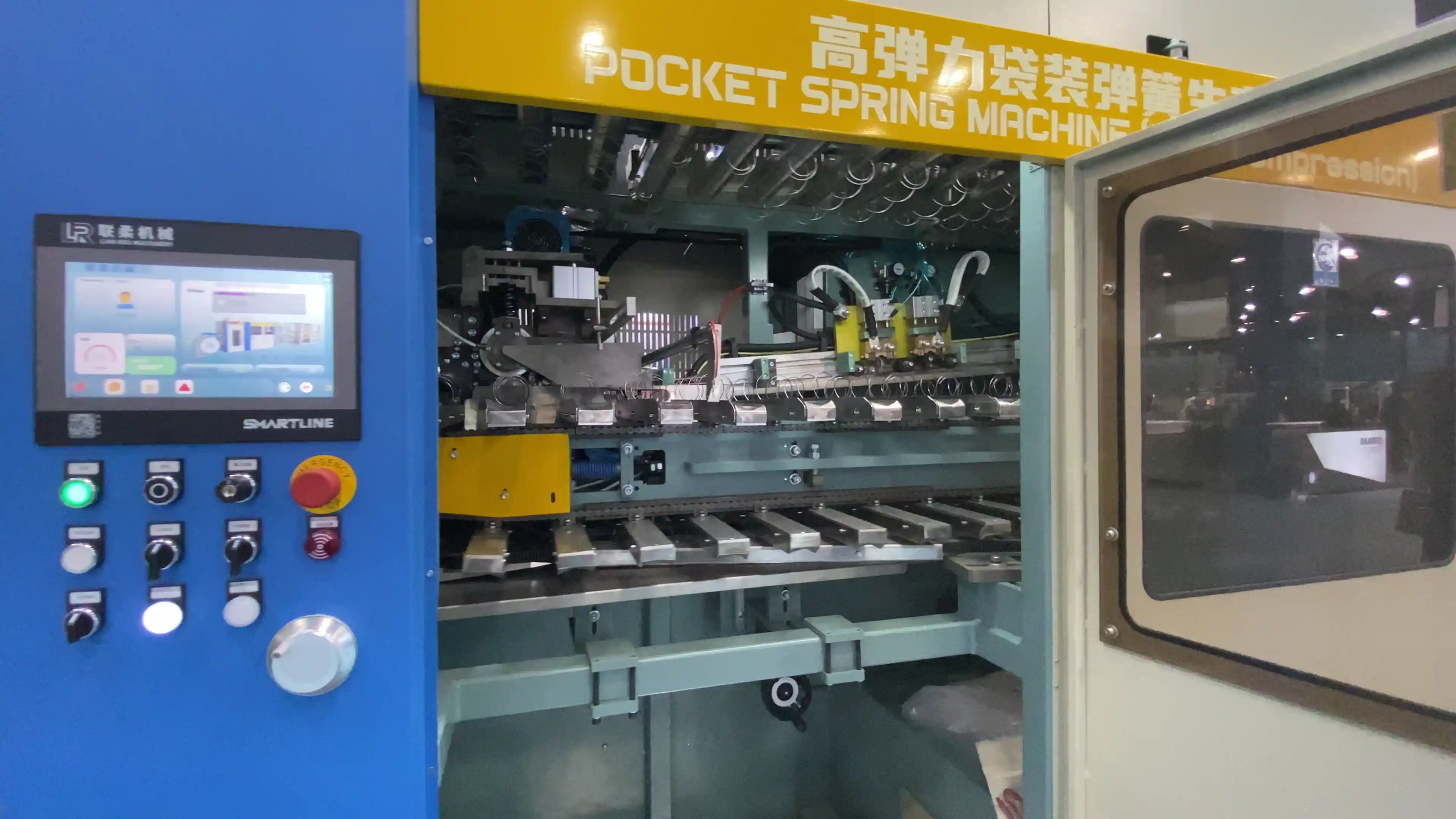
Why is "Pocket Spring Machine with Heat Treatment" a mandatory spec for global buyers? Coiling steel wire induces massive internal mechanical stress. Without immediate relief, the springs will suffer from premature deformation, fatigue, or breakage over time. The integrated thermal treatment system precisely controls temperature and duration to eliminate these stresses, delivering exceptional rebound memory, high fatigue resistance, and extended product lifespans.
After thermal stabilization, the spring is mechanically compressed to its target height and pushed into a forming non-woven fabric sleeve. The pocket is then sealed using ultrasonic welding technology. Ultrasonic sealing is the gold standard for high-speed lines because it provides incredibly strong bonds, uses minimal energy, and operates at rapid cycle times.
Finally, the machine tracks the count and length of the pocketed spring string. Once the preset configuration is met, an automated cutting blade cleanly separates the string. The finished pocket spring rows are continuously fed forward, ready for the next phase of assembly.
The global bedding and seating industries have experienced a massive paradigm shift from interconnected network springs (like Bonnell) to independent pocket springs.
Traditional sofa construction relies on high-density foam or zigzag springs, which are highly prone to sagging, permanent compression deformation, and localized structural fatigue.
The High-Compression Sofa Spring Revolution: Historically, pocket springs maxed out at around 35cm in height, meaning sofa makers had to stack multiple layers of spring units to build full-scale seating bases. Thanks to innovations from industry leaders like LianRou Machinery, specialized high-compression pocket spring machines can pre-compress a 50cm-tall spring down to a 35cm pocket with a 100% compression ratio. LianRou’s latest advancements even enable pocket springs up to 60cm tall, completely replacing traditional solid wooden or heavy metal sofa bases, dropping material costs significantly, and fundamentally changing how upholstered furniture is engineered.
Investing in standalone machinery is rarely enough for a scaling factory. To maximize efficiency, a complete pocket spring production line operates from raw materials to final packaging through integrated stages:
· Component Production: Pocket Spring Machine transforms steel wire and non-woven fabric into pocket spring strings.
· Core Assembly: Pocket Spring Assembly Machine uses automated hot-melt glue patterns to join spring strings into multi-zone innersprings (3-zone, 5-zone, 7-zone, etc.).
· Comfort Layering: Mattress Cotton Layer Gluing Machine, automatically applies and bonds comfort materials like latex, memory foam, or PU foam to the spring core.
· External Sewing: Mattress Tape Edge Machine, automatically flips and sews the quilted decorative panels and border fabrics together to seal the mattress.
· Logistics Optimization: Mattress Compression & Roll-Packing Machine, Compresses, vacuum-seals, and roll-packs the finished mattress, shrinking its volume by over 50% for optimal shipping.
When auditing mattress machinery suppliers, avoid focusing solely on the initial price tag. Assess these critical operational parameters:
As Manufacturing 4.0 matures, pocket spring machines are evolving rapidly across four key pillars:
Yes, provided the machine features a versatile CNC control system and a wide mechanical tolerance range. Advanced machines can easily switch parameters to handle the thicker wires and high-compression profiles typical of sofa springs, alongside traditional mattress configurations.
Ultrasonic welding utilizes high-frequency acoustic vibrations to melt the synthetic fibers of non-woven fabric together instantly. It requires no consumables (like thread or needles), operates at significantly higher speeds, uses less energy, and yields a structurally superior weld that will not unravel under heavy loads.
Daily routines involve clearing out metal dust particles and verifying wire alignment guides. Weekly/monthly checks should focus on lubricating mechanical joints, assessing ultrasonic horn wear, and checking the performance of the heat treatment heating elements to ensure uniform heat distribution.
Selecting the right spring coiling machine is the single most important infrastructure decision for determining product quality and long-term profit margins. As a premier manufacturer of advanced mattress machinery, LianRou Mattress Machinery delivers state-of-the-art spring coiling systems, high-speed pocket spring machines, and fully automated turn-key production lines. Designed to lower labor overhead, eliminate material waste, and maximize throughput, LianRou helps factories around the world transition seamlessly into modern, sustainable automated manufacturing.


TOP
