Guide ultime des machines à ressorts : types, applications et solutions de fabrication
Date:
What is a spring machine, and how do B2B bedding and furniture manufacturers choose the right machinery to scale production? A spring machine is an automated industrial system engineered to transform high-carbon steel wire into precision spring coils—such as pocket springs, Bonnell springs, or specialized microcoils—used across mattress, sofa, furniture, and ergonomics manufacturing. B2B purchasing teams at mattress factories, sofa plants, and pillow manufacturing facilities face recurring operational bottlenecks: rising raw material waste, inconsistent spring coil height, high labor turnover on manual assembly lines, and slow machine cycling speeds that constrain daily plant throughput. Modern high-speed spring machine solutions directly solve these friction points by integrating CNC servo-driven coiling, automated heat-treating modules, real-time ultrasonic pocket fabric welding, and inline quality control systems. By upgrading from legacy mechanical coilers to advanced automated machinery, commercial manufacturers can increase output by 30% to 50%, reduce wire breakage rates below 0.1%, and lower unit production costs—delivering the precise firmness, durability, and ergonomic support demanded by global wholesale distributors and B2C retail brands.
What Is an Industrial Spring Machine and How Does It Work in B2B Manufacturing?
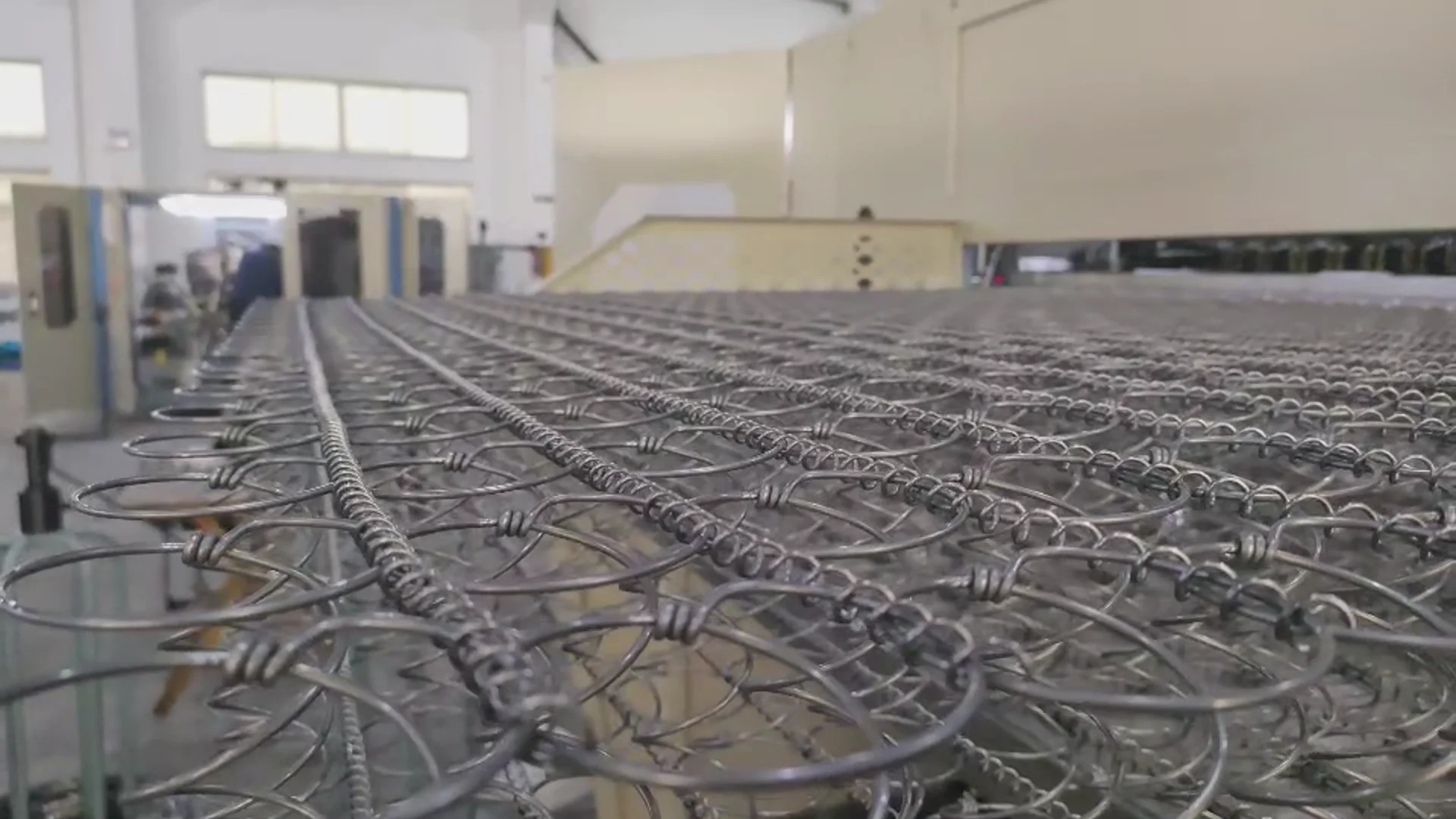
An industrial spring machine is a specialized piece of automated equipment designed to process wire rods into structured cushioning components for mattresses, upholstery, and anatomical support products. Every major B2B bedding and furniture producer relies on these automated units as the primary engine of their coil production line. Understanding the mechanical workflow of a modern coiling machine is critical for plant managers evaluating machinery upgrades or expanding facility capacity.
The manufacturing process follows five main technical steps:
Wire Feeding and Pay-Off System: High-carbon spring steel wire (typically 1.3mm to 2.4mm in diameter) is uncoiled from a heavy-duty pay-off stand using variable-frequency tension control to ensure uniform wire feed without tangles or surface friction.
CNC Multi-Axis Coiling: Multi-axis CNC servo motors drive hardened tungsten carbide tools to bend, pitch, and form the wire into precise coil geometries—ranging from cylindrical and hourglass shapes to multi-zone barrel profiles.
In-Line Induction Heat Treatment: Immediately after coiling, the springs pass through an inline electrical thermal treatment zone to relieve internal steel stress, locking in spring memory, height uniformity, and long-term fatigue resistance.
Fabric Encapsulation or Mechanical Knotting: Depending on the coil style, the springs are either fed into non-woven polypropylene pockets using ultrasonic sealing or transferred to knotting mechanisms for interconnected wire frameworks.
Automated Array Assembly: The individual spring units are grouped, glued, or clipped into complete support cores ready for downstream mattress tape-edging, sofa frame fitting, or pillow insertion.
According to research published by the International ISO Standards for Metallic Springs (ISO 26909), precise thermal stress relief and dimensional tolerance control during automated coiling directly determine the fatigue life and cyclic load limits of steel springs in commercial bedding applications.
How Many Types of Spring Machines Exist for Commercial Production?
Selecting the correct spring machine depends on the specific structural profile, pocket design, and coil configuration required by your end products. In the commercial bedding and upholstery sectors, machinery falls into four primary equipment classifications:
To optimize capital expenditure, procurement teams evaluate each category against target production volumes:
High-Speed Pocket Spring Machine: Built for flexible zoning, silence, and independent motion isolation, this machinery type coils wire, heat-treats it, and seals each spring into ultrasonic-welded fabric pockets in one uninterrupted cycle.
Automated Bonnell Spring Machine: Engineered for durability and high-volume basic support units, these machines form traditional hourglass springs and automatically knot the terminal ends to prevent fabric puncture.
Continuous and LFK Spring Coiler: Designed for maximum structural stability per square meter, producing open-offset coils that offer firm edge-to-edge support for hospitality and orthopedic applications.
Micro-Coil and Cushion Spring Unit: Compact coiling systems configured to handle ultra-thin steel wire, producing mini spring layers that replace polyurethane foam in breathable pillows and luxury mattress toppers.
What Types of Springs Can Different Spring Machines Produce?
An enterprise-grade spring machine offers high adaptability, allowing operators to change wire gauges, coil diameters, pitch distances, and turn counts via software parameters. Understanding which coil geometries correspond to specific machinery configurations helps manufacturers match equipment capabilities with market demands.
·Barrel-Shaped Pocket Coils: Produced on advanced pocket coil equipment, these springs taper slightly at the top and bottom. This shape allows the coils to compress smoothly inside non-woven fabric sleeves without rubbing against adjacent springs, ensuring silent performance and superior point elasticity.
·Hourglass Bonnell Springs: Formed on heavy-duty Bonnell coilers, these springs feature a wider outer diameter at the ends and a narrower center waist. Under light loads, the soft outer coils yield easily; under heavier pressure, the central waist provides firm resistance, making them ideal for long-lasting commercial bedding.
·Zoned Pocket Springs: Created using multi-gauge pocket coiling systems that alternate wire diameters (e.g., 1.8mm for lumbar support and 1.6mm for shoulder comfort) within a single continuous fabric strip, enabling ergonomic multi-zone bed core production.
·Mini Micro-Coils: Produced on specialized micro-coil machinery, these low-profile springs (ranging from 15mm to 50mm in height) deliver dynamic airflow and resilient surface contouring, serving as an eco-friendly alternative to synthetic latex and memory foam layers.
What Are the Final Applications of Spring Machine Coils Across Bedding and Furniture?
Coils manufactured by specialized spring machine installations serve as the core support engine for multiple commercial furniture and home comfort sectors. Procurement managers match equipment investments directly to downstream product requirements:
Mattress Manufacturing Plants: Modern bed factories utilize high-output pocket spring coiling and assembly lines to build multi-zone pocket units, edge-reinforced hybrid beds, and roll-packed mattresses designed for efficient box shipping.
Sofa and Upholstered Furniture Production: Furniture factories integrate pocket spring units and sinuous springs into sofa seating cushions, deep-lounge couches, and sectional sofas to retain shape memory, prevent foam sagging, and extend product lifespan.
Ergonomic Pillow and Cushion Manufacturing: Specialty pillow manufacturers deploy micro-spring arrays encased in gel-infused memory foam or natural cotton covers, providing dynamic neck support and continuous thermal ventilation superior to solid foam blocks.
Office Seating and Automotive Interiors: High-durability micro-coils are increasingly embedded in commercial task chairs, executive seating, and vehicle seats to reduce heat accumulation and offer dynamic pelvic support during long sitting periods.
How Do B2B Buyers Evaluate Spring Machine Technical Parameters Before Purchase?
When investing in industrial production assets, B2B procurement managers, technical directors, and factory owners must evaluate equipment based on measurable performance parameters. Standardized engineering specifications ensure that a new spring machine aligns with factory power grids, floor space, material inputs, and target ROI schedules.
Key engineering metrics to demand from your mattress machine manufacturer include:
Coiling Speed and Throughput: Measured in coils per minute (e.g., 180–260 coils/min for pocket units). Higher linear speeds must be supported by real-time wire tension control to avoid dimensional drift.
Wire Gauge Versatility: The capability to handle high-carbon steel wire diameters ranging from 1.3 mm to 2.4 mm without requiring lengthy manual mechanical re-tooling.
Ultrasonic Welding Stability: For pocket coilers, the ultrasonic generator power (typically 20 kHz frequency) dictates seam strength and non-woven fabric bonding speed without burning the material.
Energy Efficiency Rating: Servo-driven motor systems lower power consumption by 20% to 35% compared to legacy hydraulic or continuous AC motor setups, directly reducing per-unit operational costs.
Machine Footprint and Automation Interface: Compact modular designs with PLC touchscreens (supporting multi-language operation, error diagnostics, and remote IoT maintenance) allow smooth integration into automated plant layouts.
To verify machinery performance, leading producers evaluate equipment from established innovators like LianRou Mattress Machinery, whose patented multi-axis servo coiling setups and high-speed pocketing technology have set industry standards for stable operation and material savings.
Key Takeaways for B2B Spring Machine Procurement
Targeted Equipment Selection: Match the coiling technology directly to product lines—high-speed pocket coilers for luxury/hybrid mattresses, Bonnell coilers for heavy-duty institutional beds, and micro-coil units for pillows and seat cushions.
Focus on Total Cost of Ownership (TCO): Evaluate servo motor energy efficiency, wire scrap rates, tool steel durability, and remote diagnostic features rather than focusing solely on upfront machine purchase price.
Demand Compliance & Standards: Ensure all machinery carries CE certification, ISO manufacturing compliance, and standardized safety guarding for high-speed mechanical operation.
Prioritize After-Sales Support: Select an established mattress machine manufacturer offering global spare parts availability, fast technical response times, and onsite operator training.
FAQ: B2B Spring Machine Purchasing and Technical Queries
Q1: What is the average payback period (ROI) for a high-speed pocket spring machine?
A1: For mid-to-large-scale mattress factories operating single or double shifts, upgrading to a high-speed pocket spring coiling line typically achieves full capital payback within 12 to 18 months through reduced labor overhead, lower scrap rates, and increased daily coil output.
Q2: How does automatic inline heat treatment affect spring quality?
A2: Inline thermal induction heat treatment instantly relieves internal mechanical stresses created during cold wire coiling. This locks in spring height, prevents shape degradation under compression testing, and ensures consistent resilience throughout the mattress lifecycle.
Q3: Can one spring machine produce different spring heights and zone firmnesses?
A3: Yes. Modern CNC servo-driven pocket spring machines allow operators to adjust spring height, coil turns, and coil diameters directly via the PLC touchscreen interface, enabling seamless transition between firm and soft ergonomic zones.
Q4: What non-woven fabric specification is recommended for pocket spring machine production?
A4: Spunbond polypropylene non-woven fabric with a surface weight between 60 g/m² and 85 g/m² is standard. It provides the ideal balance of tensile strength, thermal weldability, and tear resistance under continuous pocket coil pressure.
<details>
<summary><strong> Livre blanc technique : Métallurgie avancée et automatisation CNC dans le fonctionnement des machines à ressorts (Cliquez pour développer)</strong></summary>
<div class="hidden-content">
<h4> Comprendre la relaxation des contraintes métallurgiques dans les systèmes de machines à ressorts à grande vitesse</h4>
<p> Dans la fabrication moderne à grand volume de literie et de tissus d'ameublement, l'intégrité mécanique dynamique d'un ressort en acier dépend fortement des phases initiales d'enroulement et de conditionnement thermique. Lorsqu'un fil d'acier à ressort à haute teneur en carbone (généralement de nuance SWC 60-80 ou EN 10270-1 SH) est formé à froid par une machine à ressorts, des contraintes internes importantes de torsion et de traction apparaissent dans le réseau cristallin du fil. Si elles ne sont pas corrigées, ces contraintes internes entraînent une perte de hauteur prématurée, une rupture par fatigue dynamique et des variations imprévisibles de fermeté au sein des âmes de matelas assemblées.
Pour éliminer ces défauts métallurgiques, les lignes de production haut de gamme de machines à ressorts ensachés et les configurations automatisées de machines à ressorts Bonnell intègrent des systèmes de traitement thermique par induction en continu. Lors de la découpe de chaque ressort par la tête d'enroulement CNC, un bras mécanique automatisé transfère la spire nouvellement formée à travers une bobine d'induction électrique haute fréquence localisée ou des électrodes chauffantes à résistance. Le chauffage du fil à une température précise (généralement entre 240 °C et 300 °C) pendant quelques secondes permet de relâcher les contraintes de cisaillement localisées sans altérer la dureté du fil. Ce processus continu de relaxation des contraintes garantit que chaque spire conserve sa hauteur libre initiale à ±1,5 mm près, même après 100 000 cycles de compression selon les protocoles de test de durabilité ASTM F1566.
Commande servo CNC avancée et technologie de pochement ultrasonique
Les machines à ressorts mécaniques traditionnelles utilisaient des cames, des engrenages et des volants manuels complexes pour régler le pas d'avance du fil et le diamètre des spires du ressort. Les environnements de production modernes exigent une transition rapide entre les produits, des configurations de matelas multizones et une réduction au minimum des déchets de matériaux. Cette évolution a incité des fabricants de premier plan, tels que LianRou Mattress Machinery et des sociétés d'ingénierie de renom, à adopter une architecture numérique CNC multiaxes dans la conception de toutes leurs machines à ressorts modernes.
Dans une machine à ressorts ensachés CNC multiaxes, des servomoteurs dédiés à couple élevé contrôlent indépendamment l'alimentation en fil, le réglage du pas, la position du coin d'enroulement et la coupe du fil. Cette conception numérique découplée permet aux opérateurs de programmer des profils de ressorts multizones complexes directement via une interface PLC tactile en quelques secondes. Par exemple, une simple bande de tissu continue peut passer automatiquement d'une zone lombaire rigide en fil de 1,8 mm à une zone d'épaules plus souple en fil de 1,6 mm sans interrompre la production.
De plus, l'intégration de générateurs de soudage ultrasonique haute puissance de 20 kHz révolutionne l'encapsulation des poches en tissu. Au lieu d'utiliser de la colle thermofusible pour former les manchons individuels des ressorts, des transducteurs ultrasoniques appliquent des vibrations mécaniques rapides au tissu non tissé en polypropylène. La chaleur de friction fusionne instantanément les fibres polymères au niveau moléculaire, créant une couture longitudinale nette et permanente qui résiste aux fortes forces de déchirure latérales lors du conditionnement en rouleaux compressés (emballage « matelas en boîte »).
Analyse comparative des dépenses d'investissement et des frais généraux d'exploitation à long terme liés aux machines.
Lorsque les équipes d'approvisionnement d'une entreprise évaluent un investissement auprès d'un fabricant de machines à matelas, le calcul du coût total de possession (CTP) nécessite de prendre en compte bien plus que le prix d'achat initial de la machine. La fiabilité des machines, l'efficacité énergétique, l'usure des consommables et les taux de rebut de fil d'acier représentent la majeure partie des dépenses d'exploitation sur l'ensemble du cycle de vie.
Comparons les indicateurs financiers d'une bobineuse mécanique classique et d'une machine à ressorts automatisée servo-commandée de pointe, fonctionnant sur un cycle standard de 5 ans :
Utilisation des matières premières : Les systèmes d'alimentation servo-commandés, équipés d'un système de détection de glissement de fil en temps réel, réduisent les taux de rebut de fil brut de 2,5 % en moyenne dans le secteur à moins de 0,2 %, ce qui représente des économies annuelles de plusieurs dizaines de milliers de dollars en fil d'acier. Économies.</li>
<li><strong>Consommation d'énergie :</strong> Les servomoteurs à fréquence variable ne consomment de l'énergie que lors du déplacement mécanique actif, réduisant ainsi la consommation d'électricité en kilowattheures (kWh) de l'usine jusqu'à 30 % par rapport aux variateurs de fréquence classiques fonctionnant en continu.</li>
<li><strong>Optimisation du tissu non tissé :</strong> Les cornes de soudage ultrasonique de précision éliminent les déchets de chevauchement de tissu, permettant aux fabricants de réduire la largeur requise des rouleaux de tissu non tissé de 5 % à 8 % par cordon de poche produit.</li>
<li><strong>Temps d'arrêt Maintenance : Les modules de diagnostic IoT à distance permettent aux techniciens hors site de diagnostiquer les codes d'erreur des automates programmables, de mettre à jour le micrologiciel des systèmes de contrôle de mouvement et de planifier la maintenance préventive, minimisant ainsi les temps d'arrêt imprévus en production.
En modernisant leurs équipements grâce à des machines à ressorts modernes et performantes, les fabricants de matelas, de canapés et de composants d'oreillers s'assurent un avantage concurrentiel durable tout en respectant les normes de qualité rigoureuses exigées par les grandes marques OEM internationales et les plateformes de vente en ligne.